


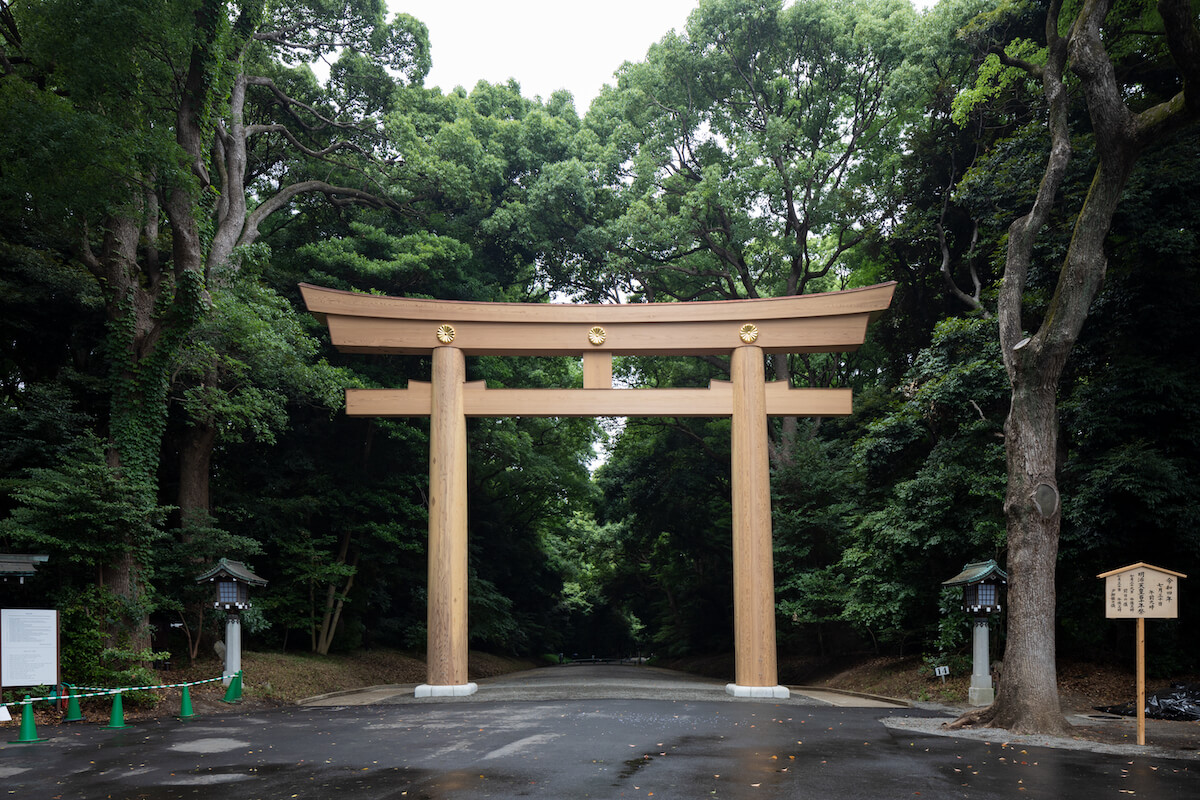
Located in the heart of Tokyo, Meiji Shrine (Meiji Jingu) is surrounded by a lush forest that offers a serene contrast to the city’s bustle. Dedicated to Emperor Meiji—who led Japan’s modernization—and Empress Shoken, the shrine has long been one of Japan’s most visited sacred sites, drawing millions each New Year since its founding.
The First Torii Gate, the traditional wooden entrance to the shrine’s south approach, stands near Harajuku Station. As a key project for the 100th anniversary of Meiji Shrine’s founding, this gate was rebuilt after a century. On July 4, 2022, a ceremony marking its completion and purification, the Shunko Kiyoharae-shiki, was held, followed by the Kuguri zome-shiki, the ritual first passing through the new structure.
The massive pillars of this new Torii were crafted from Yoshino Cedar grown in Kawakami Village, Nara Prefecture. To build a gate of this magnitude—standing 10.1 meters tall with a 15.6-meter-long Kasagi, the principal horizontal beam, timber was sourced from all over Japan, led by the selection of Yoshino Cedar. The project was successfully brought to fruition by the collective efforts of countless people.
We spoke with several key figures involved in the rebuilding project to bring you the inside story of how the new First Torii Gate was brought to life.
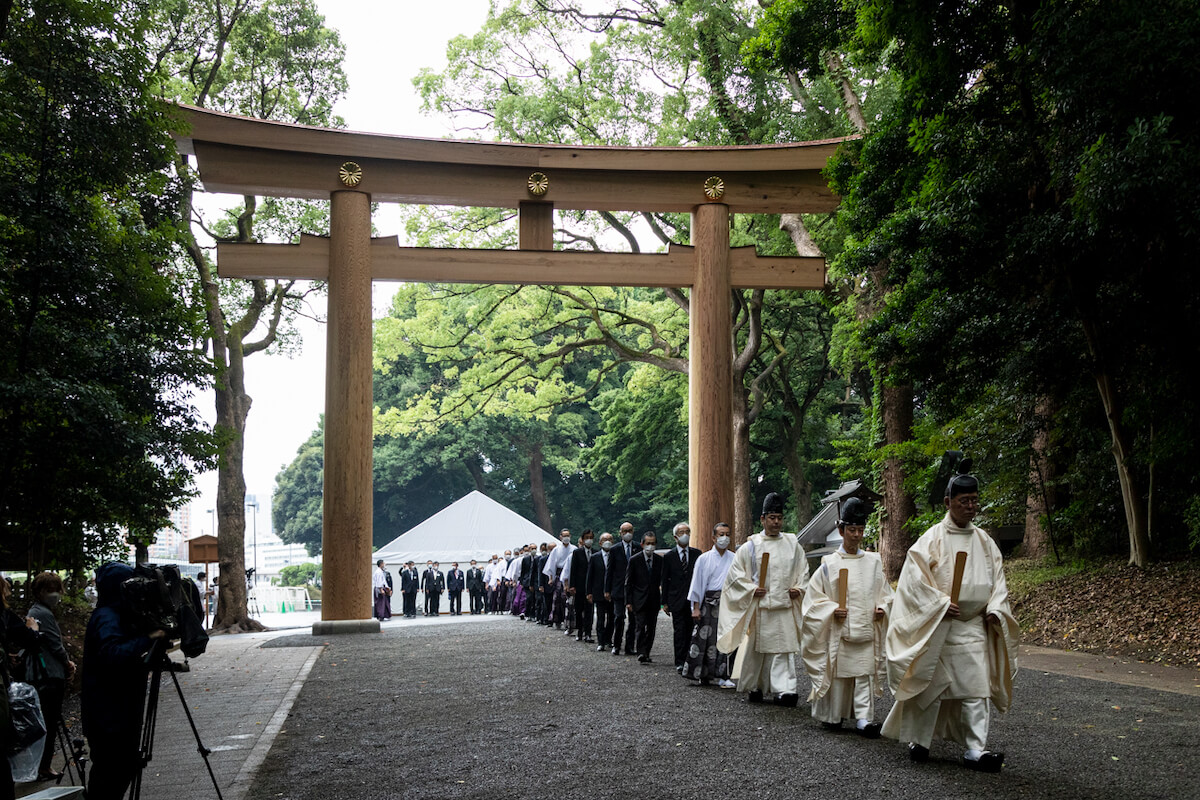
Photo courtesy of Meiji Shrine
A Two-Year Search for Timber: The Story of Finding the Perfect Yoshino Cedar for the Pillars
Meiji Shrine was established in 1920. Initially, all the shrine’s Torii gates were constructed using Taiwan Cypress. Historically, subsequent restorations relied on either Taiwan Cypress or domestic Japanese Cypress. However, with the logging of Taiwan Cypress now banned, and finding domestic Japanese Cypress that met the size requirements of the original Torii proving exceptionally difficult, two full years were dedicated to finding a suitable alternative material. This raises the question: Why was cedar chosen for this rebuilding? We interviewed representatives from Meiji Shrine to get the answer.
“Amid various options, including, foreign timbers, glulam, and hybrid materials combining wood and steel, we decided upon the intention of using domestic Japanese wood Shiraki, plain untreated wood. After this decision, cedar was determined to be the most appropriate and domestically procurable timber available.
For the two main pillars of the First Torii Gate, we used Yoshino Cedar, while the Kasagi, topmost beam, and Shimaki, the long horizontal beam beneath the Kasagi, utilized cedar sourced from different regions. This makes it the first cedar Torii within the shrine grounds. Wood evokes reverence for nature and conveys warmth and beauty that man-made materials cannot replicate. The grain of the Yoshino Cedar pillars conveys the vital strength nurtured by the land of Yoshino and the blessings of the heavens. The fragrant cedar has resulted in a beautiful finish, and upon seeing the completed First Torii Gate, a single feeling surged within us: simply, ‘deep gratitude.'”
In order to maintain the size and shape of the original Torii, lumber measuring 15 meters in length and 5 meters in circumference at breast height was required. Finding timber of this magnitude within Japan proved to be an extremely difficult challenge. Starting with the search for standing trees suitable for the pillars, on-site surveys were conducted in numerous forests across the country.
Mr. Kaimoto, Chairman and President of YoshinoMeibokuSeizoHanbai, Inc., who was involved in the lumber selection process, stated, “It was difficult to find trees that met the conditions, and even when we did, there was the problem that they were often in locations that made extraction extremely challenging.”
He continued: “It was at that point that I remembered a thick tree remaining in our company’s owned forest in Takahara, Kawakami Village. Upon checking, its circumference was about 4.9 meters, almost exactly the size we were looking for. Fortunately, we were able to find the second tree in the same area. Finding lumber of this size—15 meters in length and with as few knots as possible all the way to the tip—is not easy. We can only say that we were lucky and felt as if this wood was truly chosen by the divine.”
Yoshino Cedar was used for both the east and west pillars: a tree estimated to be about 280 years old was used for the east side, and one about 260 years old for the west, ensuring both sides were matched with Yoshino Cedar.
Logging in a Sacred Atmosphere: The Tense Process of Extraction and Milling
Four months after the candidate trees were discovered in Kawakami Village, the Misoma Hajime-sai, Shinto ritual performed before felling sacred trees, was held in December 2014 to begin the logging process. It is said that as the preparations for the ceremony were underway, snow began to fall, dusting the surrounding mountains white and enveloping the entire ritual in a sacred atmosphere.
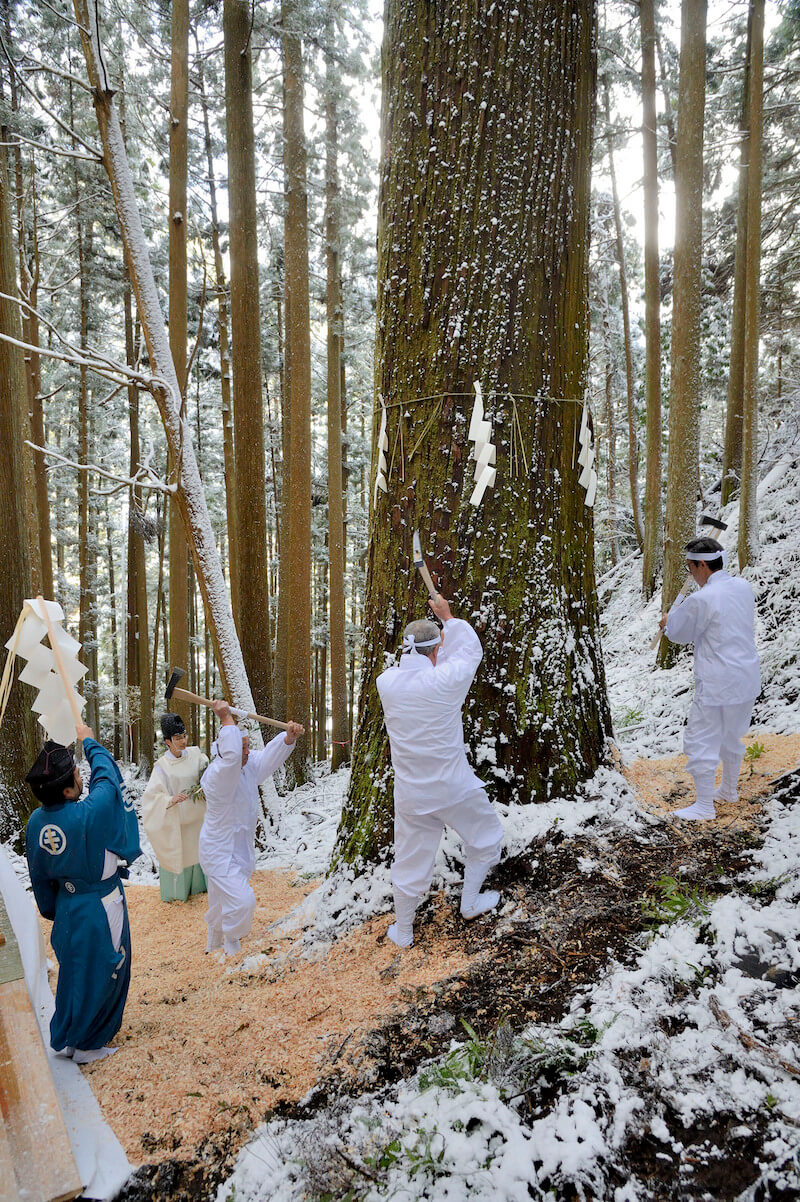
Photo courtesy of NARU Architectural Photography Office
Before felling, the direction of the fall was determined, and seven or eight surrounding trees that might potentially be hit were cut down in advance to ensure the targeted tree would not be damaged. Furthermore, branches were meticulously laid out like a cushion to prevent scarring from rocks or stumps. The team then succeeded in felling the tree after repeatedly adjusting the cutting angle with chainsaws to keep the direction of the fall precise.
After checking the condition of the cut wood for damage or knots, a process called “leaf-drying,” a traditional method of seasoning timber where the branches and leaves are left attached on site to draw out a large amount of moisture from the wood and improve its color, was carried out over 12 months.
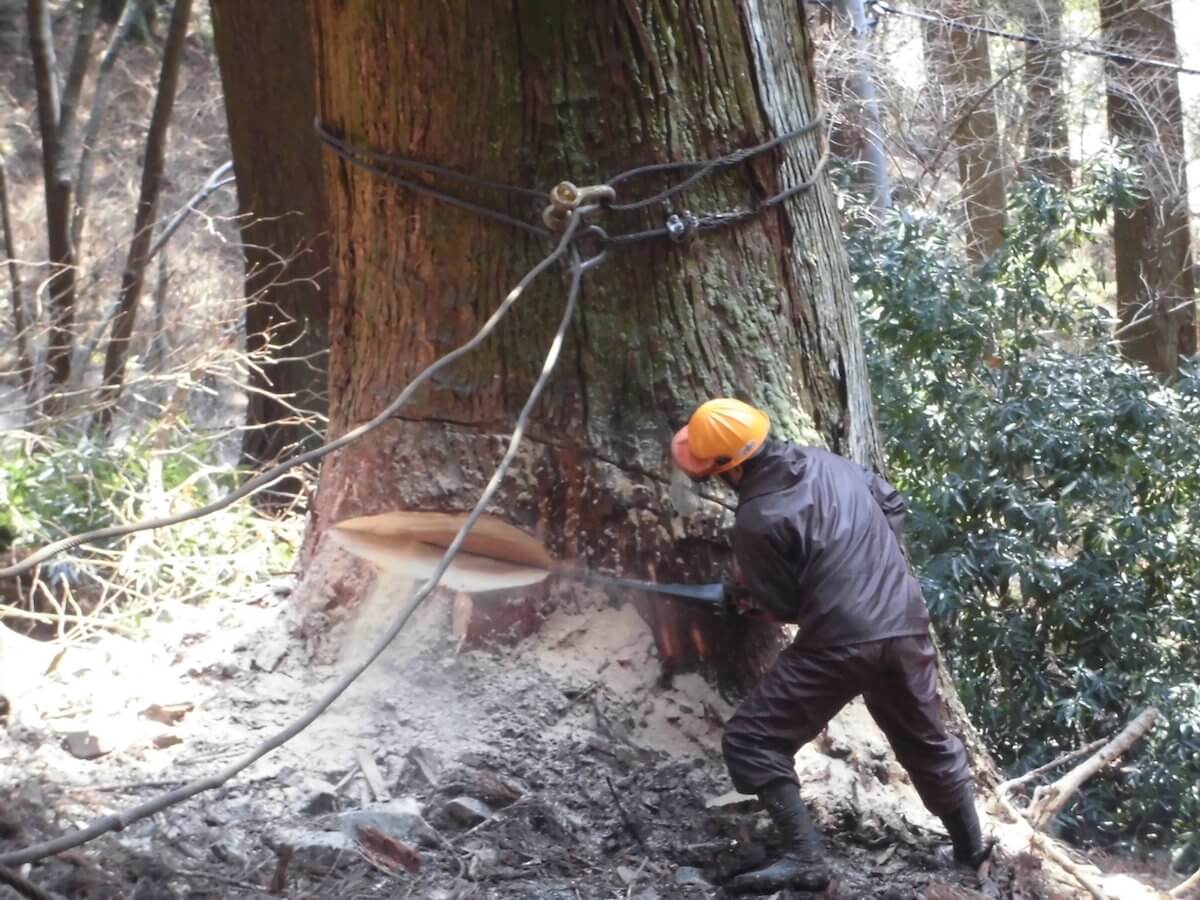
Photo courtesy of Shimizu Corporation
After the leaf-drying process, the extraction work began, which involved creating a path to bring the timber down the mountain. Even Mr. Uehira of Uehira Forestry, who undertook the felling and extraction for YoshinoMeibokuSeizoHanbai, Inc. and has experience handling large-diameter timber, recalled that transporting trees of this massive size was a deeply frightening task.
He reflected: “The trees were located on a mountainside about 50 meters away, separated by a river, and we had to carry the wood across the river to get it out. We consulted with local forestry specialists and also enlisted the cooperation of construction workers to build the necessary path. Finally, we had people skilled in handling large-diameter wood carry out the felling and extraction. This type of work cannot be done without the help of nature’s forces. I was relieved that we were able to transport the timber without any damages.”
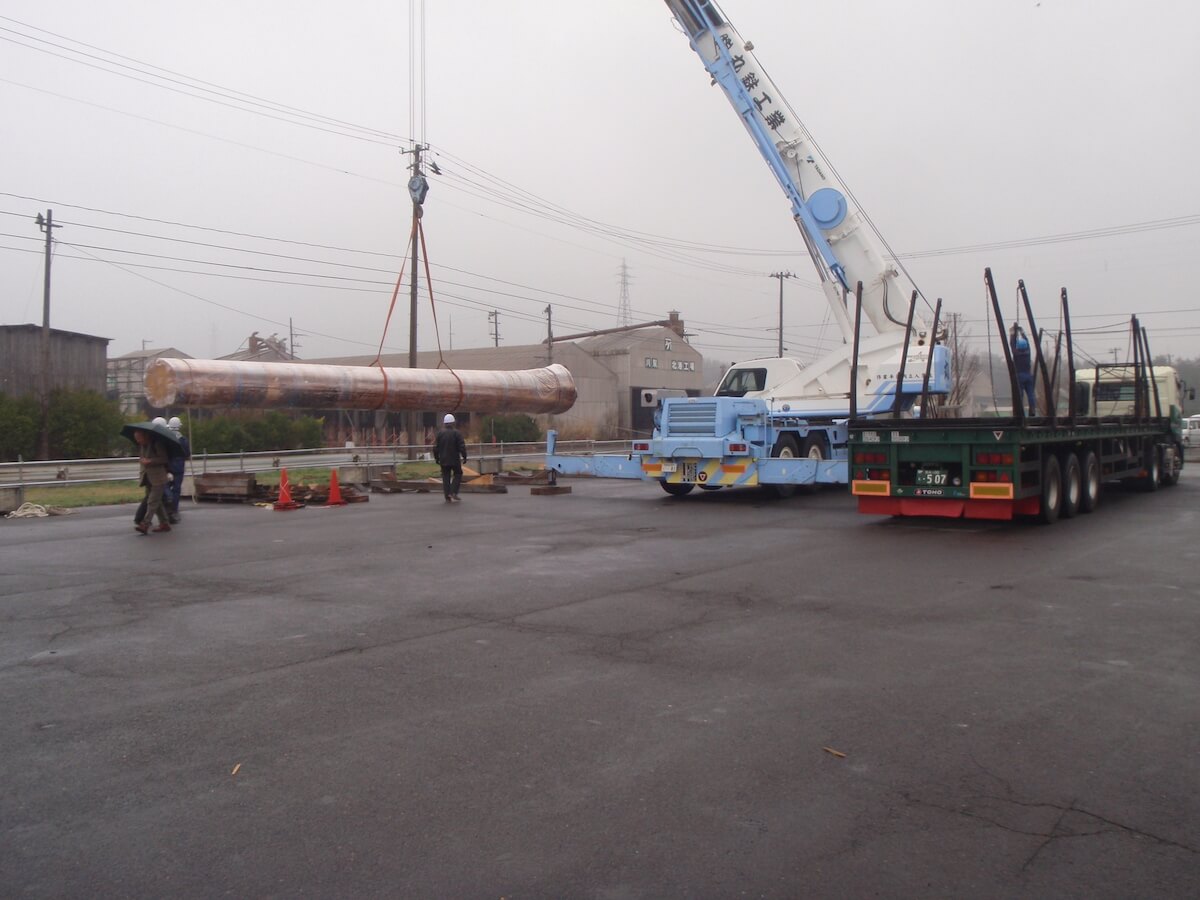
Photo courtesy of Mototate Co., Ltd.
The timber, transported from the mountains of Yoshino imbued with profound significance, was moved to the workshop of Miyadaiku, an expert temple and shrine carpenters, with a milling facility Mototate Co., Ltd. in Yamagata prefecture in the Tohoku region of Japan where approximately 600 km away from Nara prefecture. There, the Chona-hajime-sai, a ritual marking the start of woodworking, was held, and the milling process began. Unlike standard construction materials, where one can select from multiple pieces, there was no replacement for this unique timber, raising the question of how to maximize its use.
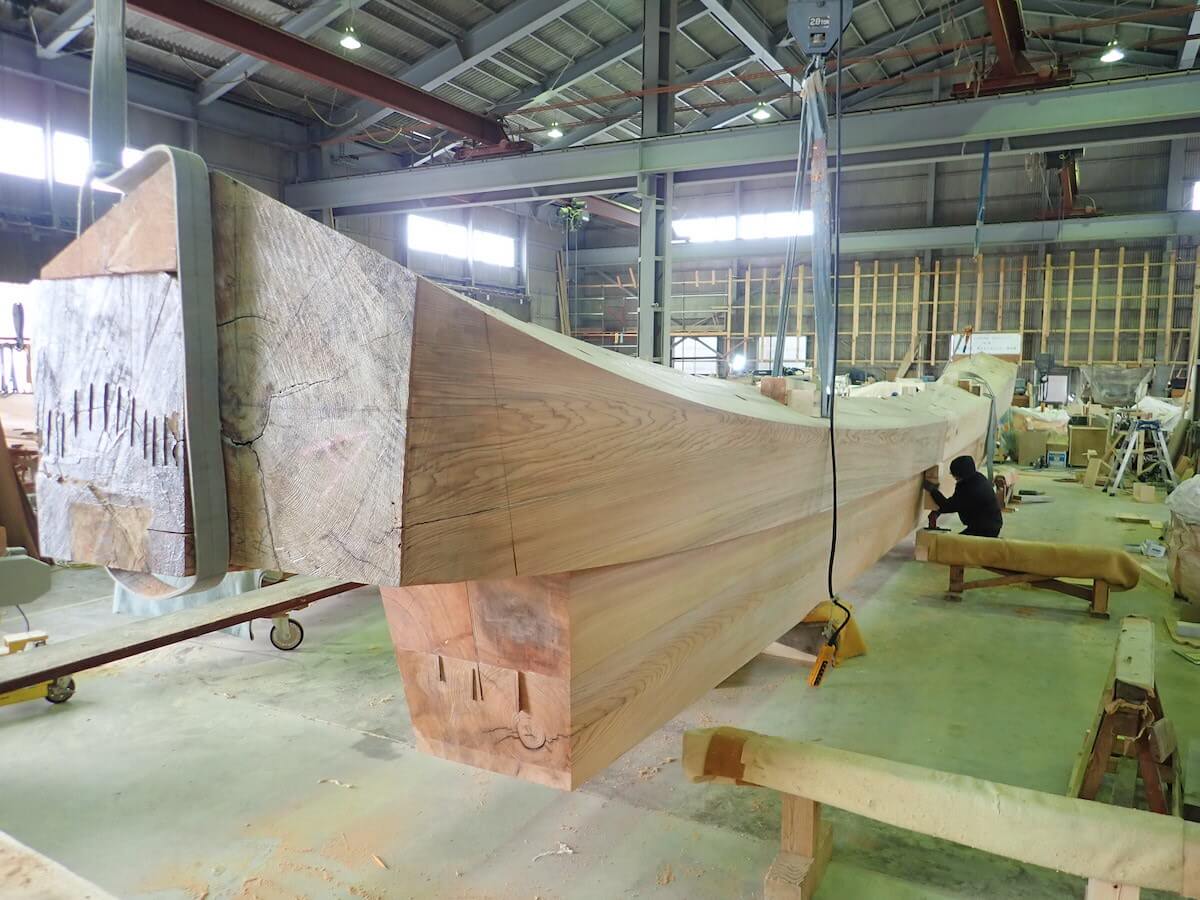
Architect Osamu Kiuchi, who handled the design, and craftsmen from Shimizu Corporation collaborated closely with Miyadaiku, and consulting repeatedly as the meticulous shaving and cutting proceeded.
“Cedar is easy to process, but conversely, it is also easily damaged. Therefore, we worked with meticulous care on how to protect the wood, including wrapping it in blankets. Since wood is a living material, and the milling was a one-shot process with no room for error, we paid close attention to the surface texture of the timber, applying precision processing down to the millimeter for the final finish. The Yoshino Cedar possesses tremendous power and presence, and its grain is beautiful. When the work was complete, we felt that a truly magnificent Torii had been created. What is so remarkable about Yoshino timber is the way the trees have been nurtured and cherished over long ages and across generations. I was impressed by the diligent maintenance and management of the forests, especially since large-diameter trees are becoming scarce and difficult to procure.”—Mr. Yonekawa, Construction Supervisor, Shimizu Corporation
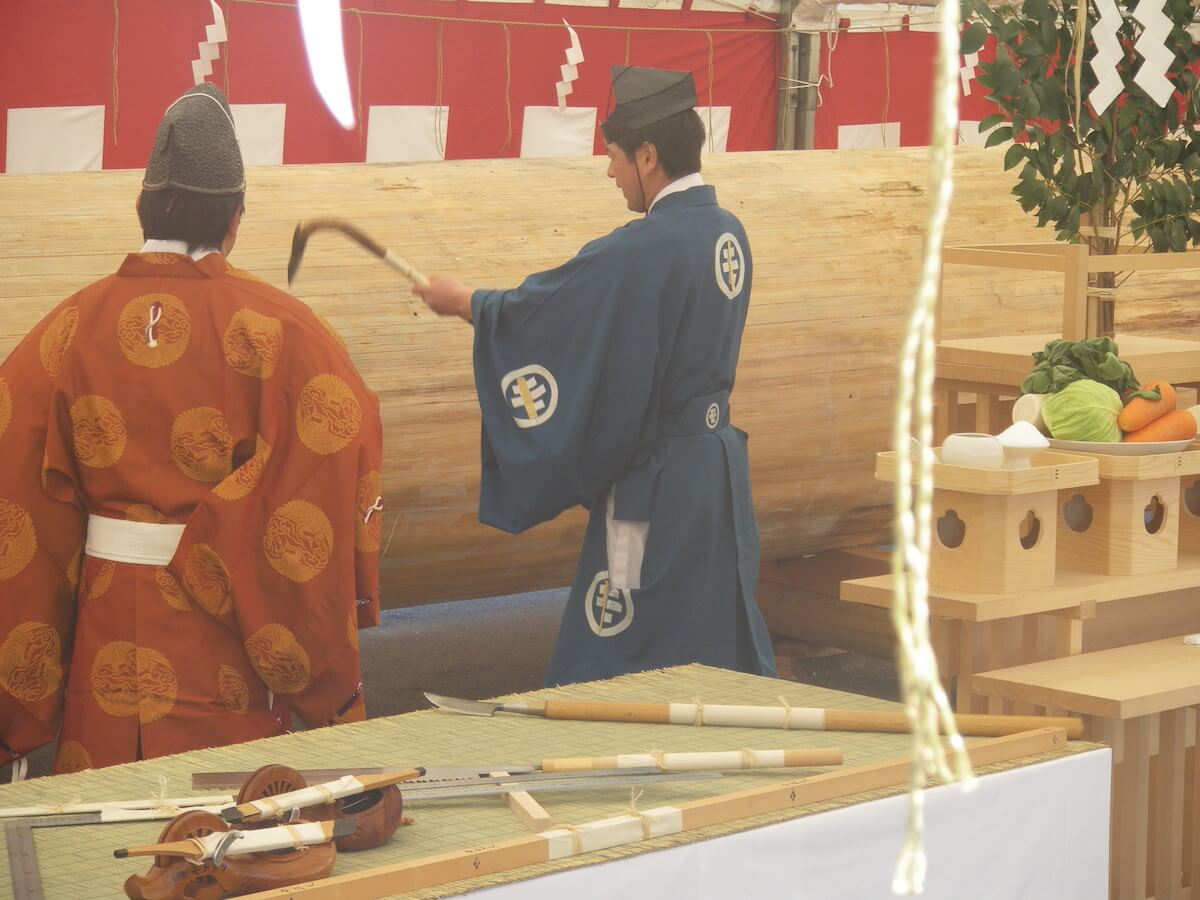
Scene from the Chona-hajime-sai (ritual marking the start of woodworking) held before the milling process began
Photo courtesy of Shimizu Corporation
It is precisely because we are dealing with natural materials that the work is difficult, delicate, and ultimately beautiful. And it is this that makes the resulting structure so special. The collective vision and passion of countless people came together to shape and finalize the timber that would become the pillars of the Torii Gate.
Upholding Tradition: Creating New Value Using Contemporary Techniques
Architect Osamu Kiuchi, who handled the design, explained: “The most challenging part of the design and processing for this rebuild after 100 years was the pursuit of good form.”
“It was decided that the shape and size must adhere to the specifications from the time of the shrine’s founding. We proceeded with the design to faithfully reproduce the overall beauty of the Torii as it stood 100 years ago. We had to determine where the excellent dignity of Meiji Shrine’s First Torii Gate originated. Since the original blueprints no longer existed, we quantified and determined the precise dimensions by referencing measured values.
For the curve of Kasagi, Shimaki, and the Entasis (the gentle bulge of the column) that makes the pillar beautiful, we ran repeated computer simulations, allowing us to generate a shape nearly identical to the measured drawings of the original Torii. While the form is ‘tradition,’ the method of creation uses contemporary technology; it can truly be called ‘the creation of tradition using contemporary technology.'”
Thus, the Meiji Shrine First Torii Gate—inheriting the size and shape from a century ago—was milled, processed, finished, and successfully rebuilt through contemporary technology and the dedication of many people. Finally, the metal fittings bearing the Chrysanthemum Crest, the emblem symbolizing the Japanese Imperial Family, that were used on the former Torii were restored and reattached.
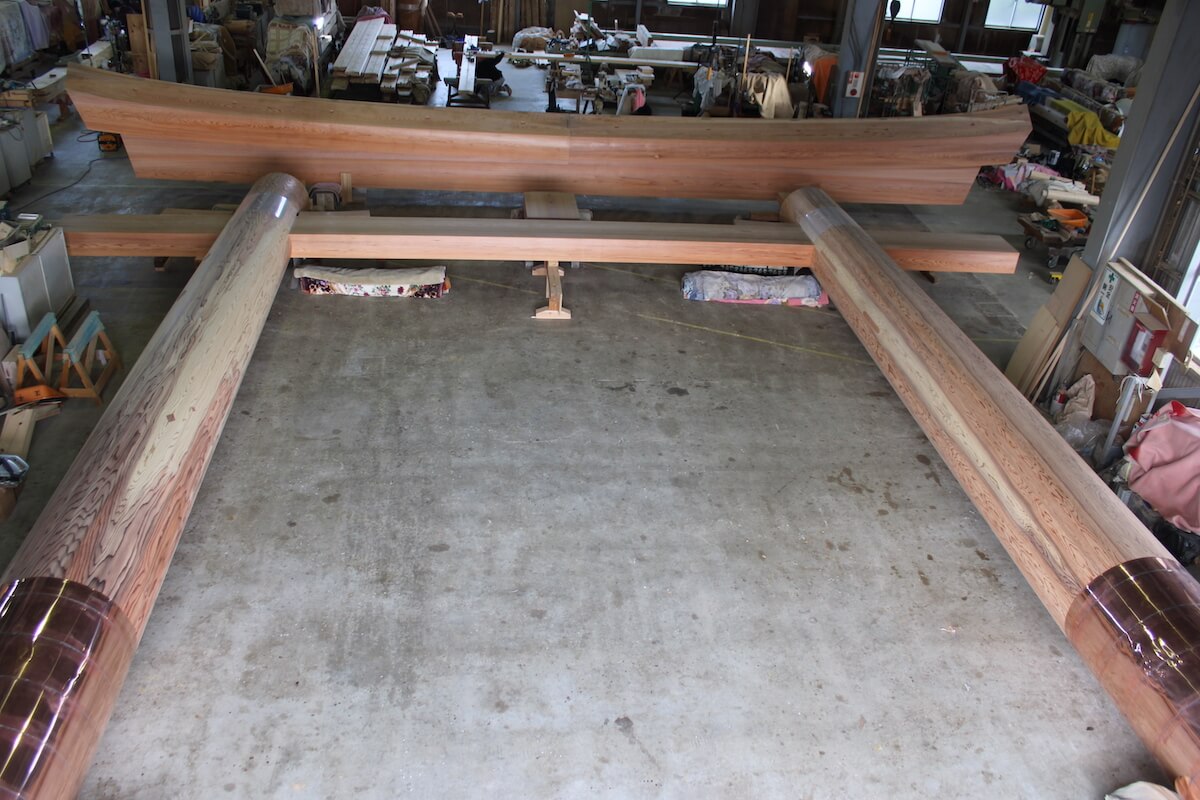
Each component of the Torii—the Kasagi (top beam), Shimaki (lower beam), and pillars—was handcrafted by skilled artisans.
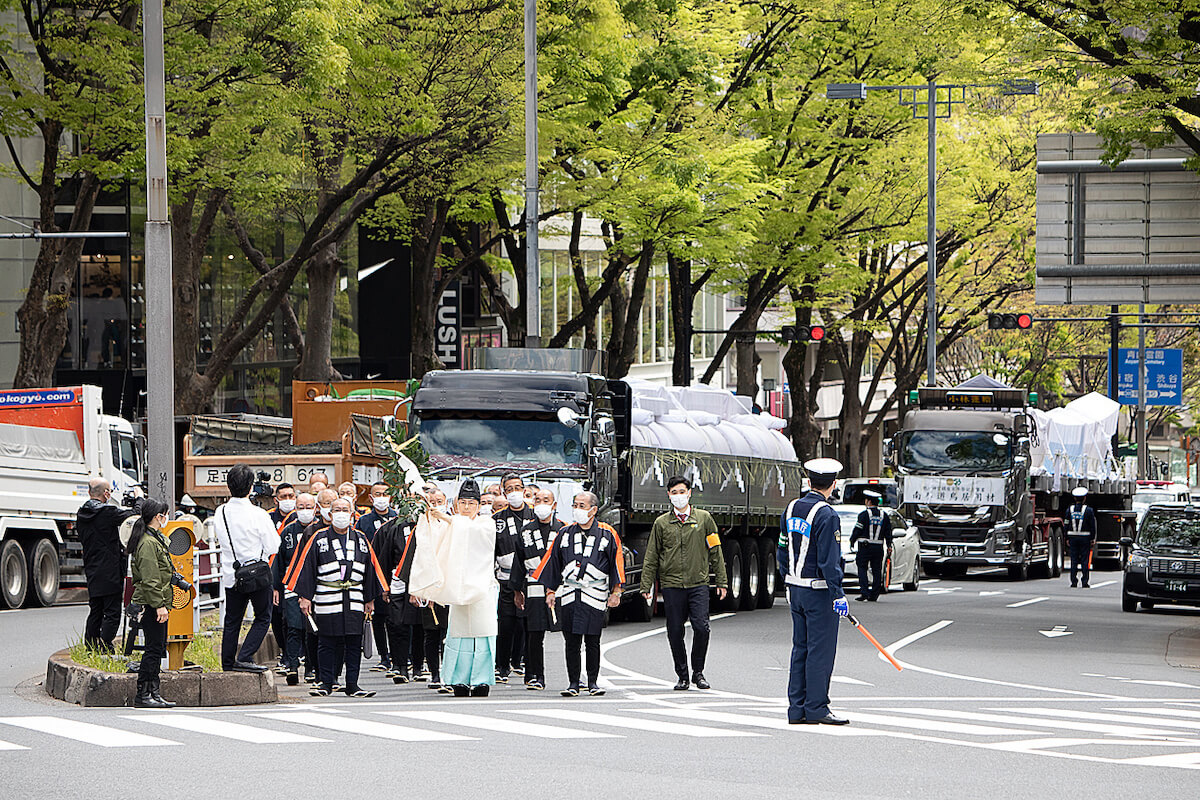
The Torii components are being transported along Omotesando to Meiji Shrine.
Photo courtesy of Kawasumi-Kobayashi Kenji Photograph Office
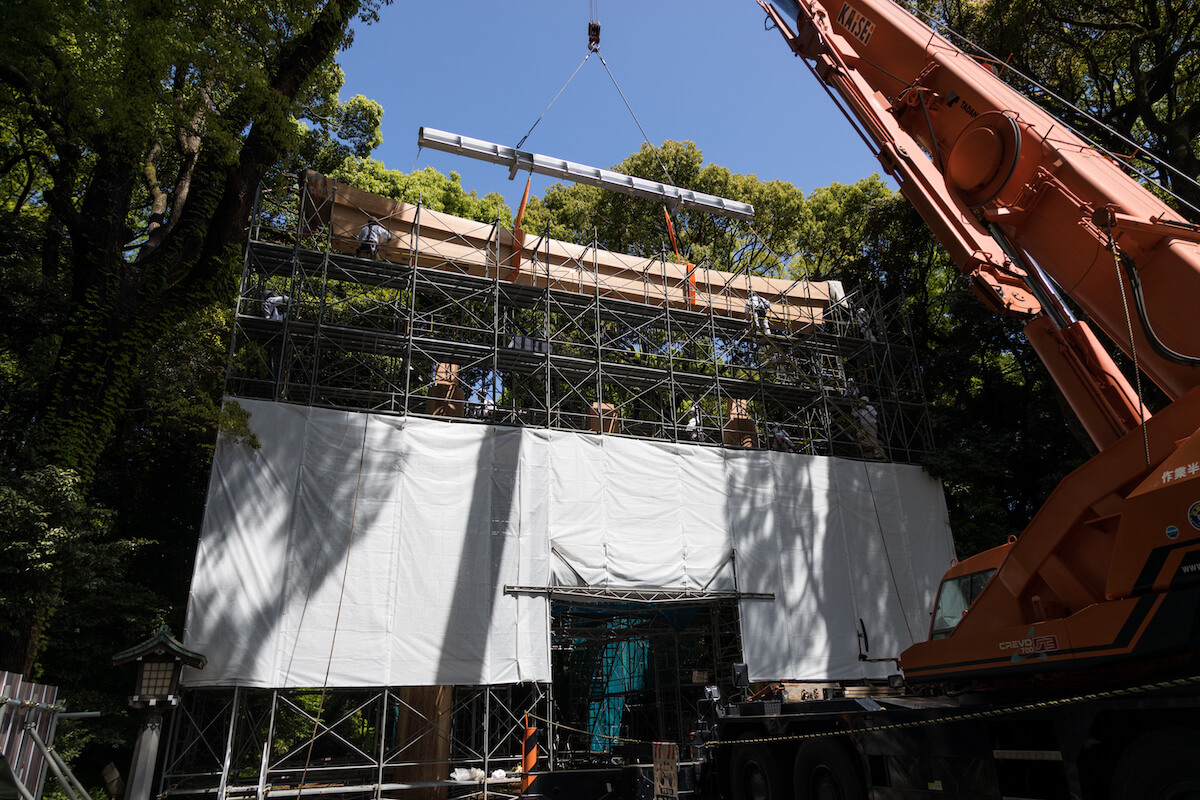
After transport, each part was carefully assembled on-site.
Photo courtesy of Kawasumi-Kobayashi Kenji Photograph Office
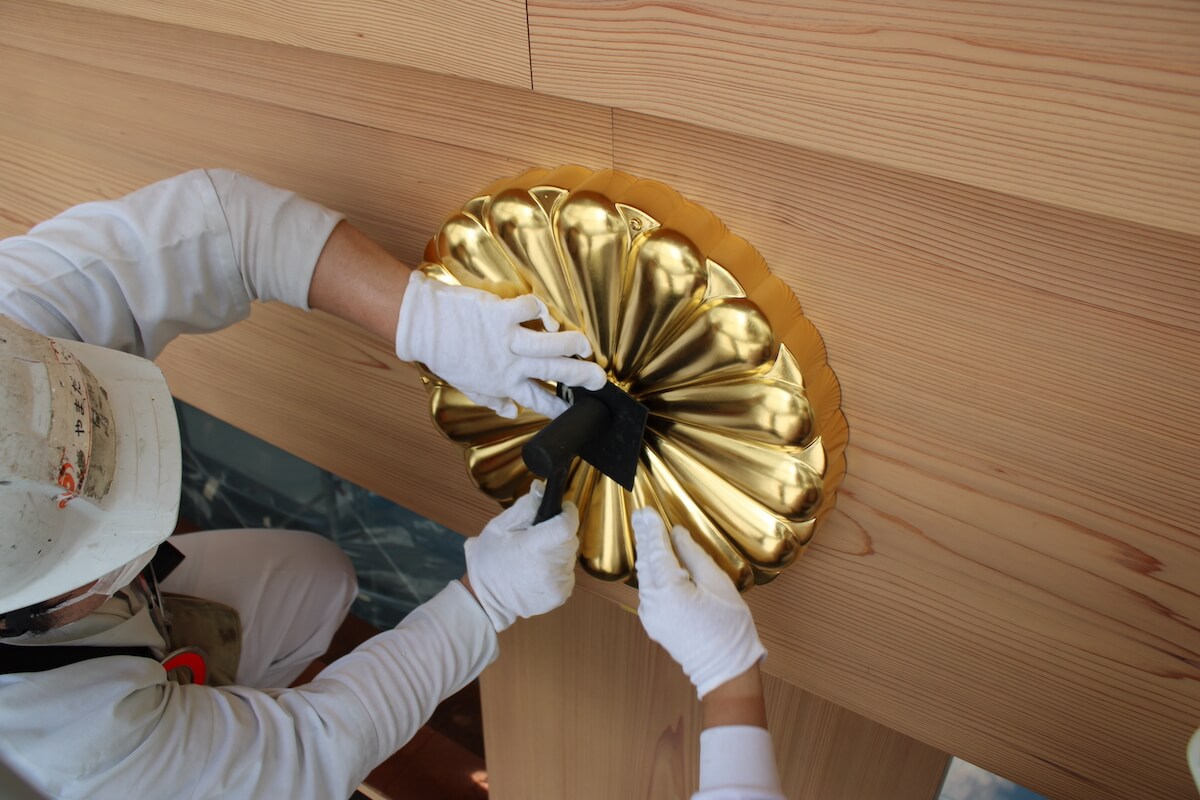
The Chrysanthemum Crest, originally used on the previous Torii, was restored and reattached to the new gate.
Photo courtesy of Shimizu Corporation
The person in charge from Meiji Shrine commented on the successful rebuilding:
“As time passes, physical structures are unavoidable subject to decay and damage. However, if they are repairable, we intend to carry on the work, cherishing the spirit and skill of our predecessors. At the same time, we believe that some craftsmanship and materials from the past may be impossible to recreate today. Therefore, we plan to consult with experts and remain committed to the spirit of Onkochishin ‘learning from the past to create new value’, just as it was in the Meiji era.
Although the appearance is the same as the former First Torii, we understand that new cedar timber—primarily Yoshino Cedar—was used, and the latest technology was employed. We believe that the deep dedication and wisdom of modern people, which is arguably equal to or even surpasses that of the time Meiji Shrine was founded, are what enabled this new Torii to be brought into being.”
The First Torii Gate has been reborn through the combined dedication of people committed to connecting tradition with the future, integrating natural beauty with contemporary technology. When you stand before it and look up, the scale of the timber, the beauty of its grain, and its gentle warmth seem to recall the landscape where these trees once stood for centuries.
This is the gateway to Meiji Shrine’s forest, which will continue to welcome visitors for the next 50 or 100 years. When you see the magnificent form of the Yoshino Cedar standing there, please take a moment to feel the connection between humanity and nature, and the fervent passion of the countless individuals who brought this Torii to life over many years.
Text: Michiko Sato
Edited by: “Nara no Ki no Koto” Editorial Team
Information
Meiji Shrine (Meiji Jingu)
1-1 Yoyogi-Kamizonocho, Shibuya-ku, Tokyo 151-8557
URL:https://www.meijijingu.or.jp/
