Discovering Yoshino Wood
-

Are Chopsticks Sustainable? Exploring the Reasons Behind Eco-Friendly “Yoshino Waribashi” from Nara Prefecture
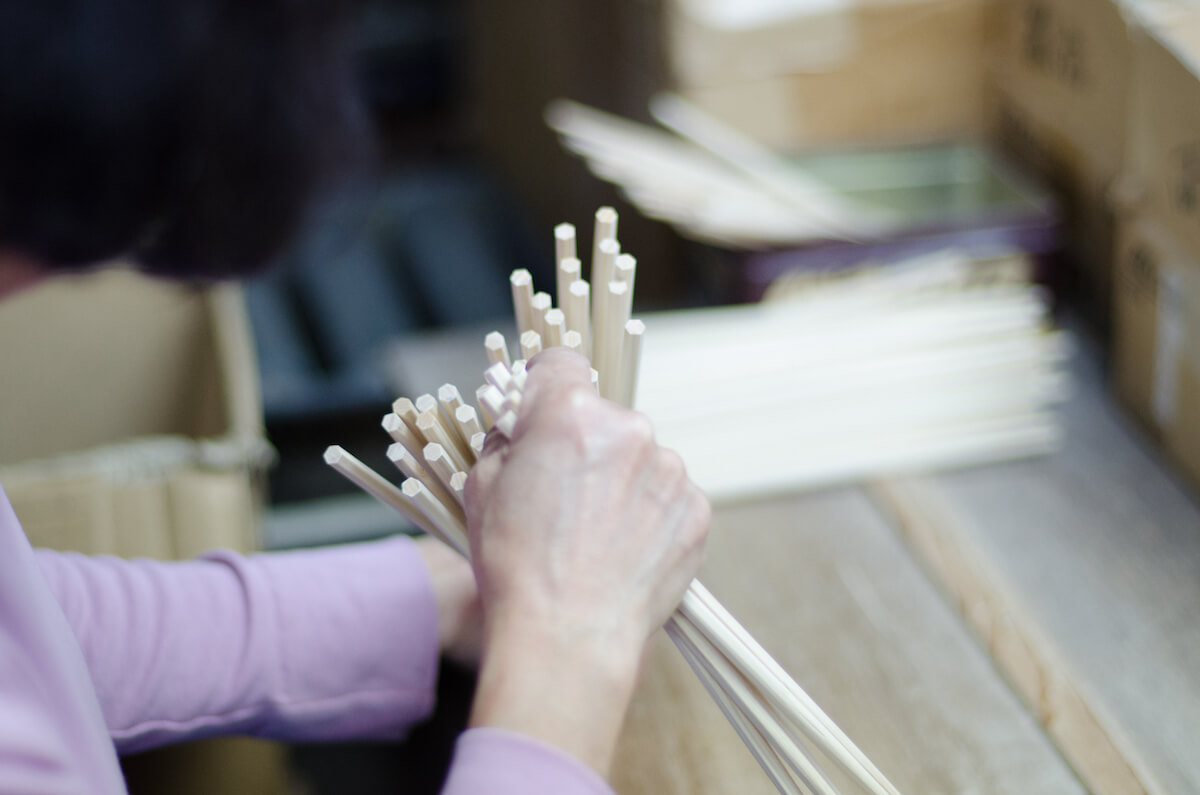
In recent years, we've seen a surge of news related to achieving a sustainable society: the rethinking of plastic straw usage, and the growing attention on products made from eco-friendly materials. One major driving force behind this is the United Nations’ Sustainable Development Goals (SDGs), a set of global objectives to be achieved by 2030. To realize a truly sustainable society, shouldn't we consider what each of us can do? The item we want to propose today is something deeply rooted in Japanese life: disposable wooden chopsticks “Waribashi.” "Is Waribashi eco-friendly? Are they sustainable?" If those thoughts crossed your mind, then this is a must-read! Born from the Spirit of “Mottainai” — History of “Yoshino Waribashi” The birthplace of disposable wooden chopsticks is said to be Shimoichi Town in the Yoshino region of Nara Prefecture, western Japan. By the Nara period (710–794 AD), chopsticks were already in common use across Japan. Later, during the Nanbokuchō period (14th century), it’s said that local villagers in Shimoichi presented cedar chopsticks to Emperor Go-Daigo, who resided at the Imperial Palace in Yoshino region. The emperor was delighted by their elegant grain and aromatic scent of the wood that he used in the morning and evening. This royal endorsement quickly led to the chopsticks being adopted by court nobles and Buddhist monks, cementing their place in Japanese culture. The story of "Yoshino Waribashi" begins in the Edo Period (1603–1868), born from a desire not to waste the residual wood from the production of tarumaru, the curved staves with Yoshino Cedar used for making sake barrels.Yoshino Cedar was highly prized and used for sake barrels because its fine, straight grain and few knots made it remarkably leak-resistant. Furthermore, sake brewed in Kamigata, around Kyoto and Osaka which was the cultural center of Japan back then, was often shipped to Edo, present-day Tokyo, in these Yoshino Cedar barrels. During the journey by boat, the sake would absorb a faint, subtle elegant scent from the cedar, delighting the people of Edo.This culture of sake barrel craftsmanship was instrumental in the development of the local forestry, leading to the rise of Yoshino Forestry as "Tarumaru Forestry", barrel-stave forestry. In the Meiji period (1868–1912), a local teacher named Tadao Shimamoto from Shimoichi designed a new “matsuba-gata” (pine-needle-shaped) chopstick—two sticks joined as one pair. This design is regarded as the origin of the modern disposable chopstick. After being commercialized, it was distributed nationwide by chopstick merchants from Tokyo. Today, “Yoshino Waribashi” are still produced mainly in Shimoichi and neighboring Yoshino Town. These chopsticks are crafted exclusively from the outermost, otherwise unusable remnants and offcuts of Yoshino Cedar and Yoshino Cypress logs from forest thinning processes instead of barrel staves. Crucially, no trees are harvested solely for the purpose of making these chopsticks but only the scraps are what remains after the trees have been milled for architectural lumber. Even sawdust produced during manufacturing is recycled into insulation, wallpaper, planting mats, or even bath additives. Used chopsticks also can be repurposed as biomass fuel or paper pulp, ensuring that nothing goes to waste. In short, “Yoshino Waribashi” embodies Japan’s timeless “Mottainai” spirit—turning “what’s left over” into something of new value. [caption id="attachment_2378" align="alignnone" width="1200"] Sawdust left from the chopstick-making process[/caption] Fine-Grained, Beautiful, and Strong — What Makes Yoshino Wood Special When you hear that “Yoshino Waribashi” are made from the remnants of lumber from forest thinning process, you might wonder: "Are they using thin or poor-quality wood?" The answer lies in the unique practice of Yoshino Forestry. In Yoshino Forestry, trees are planted in high density. This intentional closeness prevents the trunks from growing too wide, producing straight timber with a remarkably uniform thickness from top to bottom. Over decades, careful thinning allows each tree to grow slowly, resulting in tight growth rings and a refined, beautiful grain. Because branches naturally fall off or are pruned while still thin, the lumber is almost entirely knot-free. The wood from forest thinning in the Yoshino region is therefore a material of exceptionally high quality, distinct from thinned lumber from other regions. And it is from the remnants and offcuts of this superior thinned material that the celebrated “Yoshino Waribashi” are made. The outer layer of cedar and cypress used for Yoshino chopsticks is pale in color, with a smooth and uniform grain that splits cleanly when snapped apart. Because of their fine annual rings, Yoshino cedar and cypress chopsticks have sufficient strength. The Spirit of Using Every Last Piece [caption id="attachment_2380" align="alignnone" width="1200"] At the entrance of a chopstick factory in Yoshino, a signboard expresses the heart behind the craft (Kobayashi Yoshino Waribashi)[/caption] <Text on the signboard> “Yoshino Waribashi carries the blessings of nature.In recent years, disposable chopsticks have been criticized as destroyers of the world’s forests—but that’s a one-sided view.In Yoshino, fine cedar and cypress are crafted into boards and beams, and the remaining offcuts are sliced thinner, trimmed, and shaved to make high-quality chopsticks.If not used, these offcuts would simply become waste.Yoshino Waribashi are works of art—a form of wisdom that carries forward the blessings of nature.” How exactly is “Yoshino Waribashi” made? The raw material used is called “Kowa”—the outermost offcut left after lumber is milled at the sawmill. Only flawless pieces without knots or decay will be selected. The wood is cut to length, soaked in water for 8–10 hours (or boiled for 3–5 hours in the case of cypress) to soften it, then shaped, chamfered, dried, and polished. While modern machinery is certainly utilized, the process isn't as simple as pushing a button and having the machine do all the work. In reality, crafting these disposable chopsticks requires multiple steps and a significant amount of time and effort. The final product is a testament to careful, multi-stage manufacturing. https://youtu.be/NRU_wPI9bVg?si=fncIdSHRS-LGYR3h Yoshino Waribashi Industrial Cooperative Association | YouTube https://youtu.be/Mzjaf7PkcmY?si=e5f_G6yFyKa-EBw- Yoshino Waribashi Industrial Cooperative Association | YouTube Every finished chopstick is visually inspected by skilled workers and graded by hand. Only those that meet strict quality standards are shipped to market. [caption id="attachment_2381" align="alignnone" width="1200"] Yoshino Waribashi completed after many production steps[/caption] In Yoshino, even local elementary and junior high schools use those chopsticks for school lunches. Once the chopsticks have been used, they are not simply discarded. The used chopsticks are collected and sent to paper mills where they are actively utilized as a raw material for making new paper. Because these trees have been carefully nurtured for decades, artisans believe it’s only right to use them fully—never wastefully. Using the lumbers from forest thinning means keeping the forest cycle healthy, too. As one craftsman put it: “Don’t hesitate to use Yoshino chopsticks just because they’re high-quality—we want people to use them every day.” Challenges: A Shortage of Successors and Declining Demand Despite their sustainability, Yoshino’s waribashi industry faces serious challenges. The industry is facing a dual threat: the youth are moving to the cities, causing a succession crisis and an aging workforce. Simultaneously, a flood of cheap imported lumber is shrinking the market for domestic wood, leading to less available Yoshino timber and fewer of the offcuts needed for chopstick production. A Small Step Toward a Sustainable Future For us in Japan, chopsticks are part of the scenery—an essential, everyday tool. But disposable chopsticks? They offer a surprisingly easy way to pay attention to the planet. “Yoshino Waribashi” is much more than just a product from a small town. They are a living culture, symbolizing the Yoshino region's deep respect for wood and their firm belief in never letting anything go to waste. This dedication to using wood completely is naturally kind to the global environment and perfectly aligns with the global mission of the SDGs. Ready to make a sustainable choice? Start small: use “Yoshino Waribashi” today as your first step toward a sustainable society! Information Yoshino Waribashi Industrial Cooperative Association100 Kuzu, Yoshino-cho, Yoshino-gun, Nara Prefecture 639-3434Tel:0746-36-6838URL:http://www.yoshinowaribashi.com/ Kobayashi Yoshino Waribashi525 Natsumi, Yoshino-cho, Yoshino-gun, Nara Prefecture 639-3446Tel:0746-32-1184 Takeuchi Waribashi381-1 Minamiohno, Yoshino-cho, Yoshino-gun, Nara Prefecture 639-3437Tel:0746-36-6823 Hirohashi Co., Ltd.558 Shinjyu, Shimoichi-cho, Yoshino-gun, Nara Prefecture 638-0045Tel:0747-52-1684URL:https://yoroshiioagari.jp/ Text: Yoshino KokuboEdited by: “Nara no Ki no Koto” Editorial TeamCooperation: Yoshino Waribashi Industrial Cooperative Association / Kobayashi Yoshino Waribashi / Takeuchi Waribashi / Hirohashi Co., Ltd.
2026.01.22
-

Interview with Two Contemporary Forest Owners: A New Form of Forestry to “Protect the Mountains”
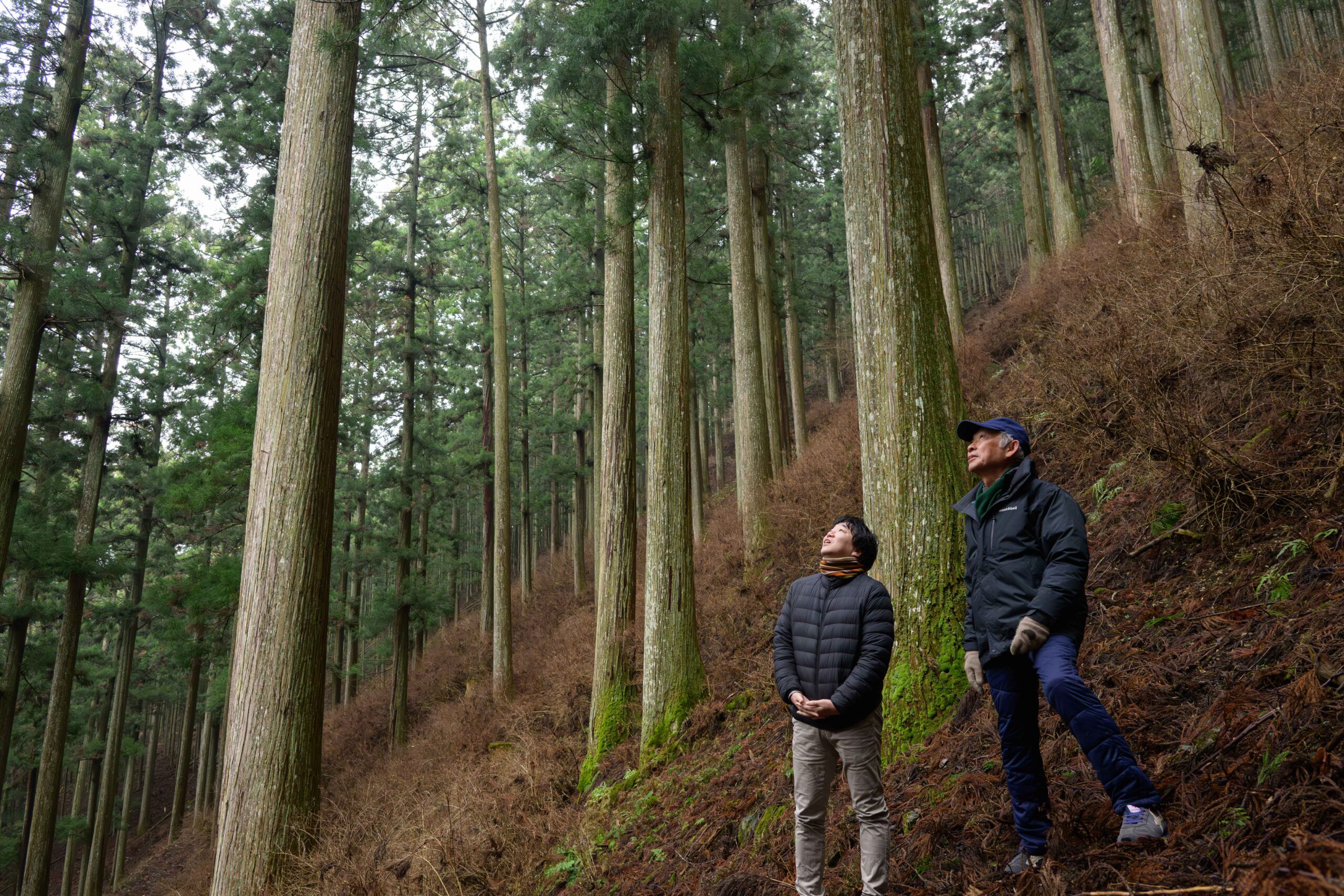
Yoshino cypress and Yoshino cedar—known for their beautiful color, minimal knots, and dense annual rings—have long been used in the construction of shrines and temples, and as material for sake barrels. In the Yoshino region of south-central Nara Prefecture, a distinctive silviculture—dense planting, frequent thinning, and long rotation periods—has produced this exceptional quality timber. The Shimotako district in Kawakami Village, Yoshino County, Nara Prefecture, known as the birthplace of Yoshino Forestry, is home to magnificent, towering trees said to have been planted during the Edo period. The beautiful, orderly rows of trees possess a majestic presence, fitting for one of the Three Great Man-Made Forests of Japan, clearly showing the long-term, painstaking care they received from human hands. However, this beautiful forest now faces a crisis: it might be lost. The demand for Yoshino timber has been declining since its peak during Japan's period of rapid economic growth (1950s–1970s), due to changes in residential construction styles. Today, the traditional forest management system—based on the partnership between the forest owner and the forest custodian—is on the brink of collapse due to a shortage of successors. We spoke with Kiyochika Okahashi, Honorary Chairman of Seiko Forestry and Shigenori Tani, President of Tani Forestry. Both were born into families of hereditary Yoshino forest owners, have witnessed the transformation of Yoshino Forestry firsthand, and are now exploring new models for the industry. We asked them about the future of forestry from the perspective of the contemporary forest owner. The two of you are what are known as Yamadanna (another term for forest owner). What generation are you, respectively? Mr. Okahashi: My family has been engaged as forest owners since the mid-Edo period (around the 18th century), and I am the 17th generation. Our ancestors served as village headmen in what is now Kashihara City, Nara Prefecture (formerly Magata Village) and were large landlords who leased out about 70 hectares of land to tenant farmers. In my father’s generation, forestry was the main livelihood, and the Yamamori (forest custodian) System was already well-established. We had 66 Yamamori managing the mountains on behalf of the owner. A chief Yamamori (Shutto) acted as the head clerk (Obangashira) managing the forestry operations. My father reportedly only visited the mountain twice in his entire life. Forest owners did not directly intervene in day-to-day management. In 1950, we founded Seiko Forestry, and began owning and managing part of the forests as a corporation, and fully developed our forestry business. This year marks our 73rd anniversary. [caption id="attachment_5381" align="alignnone" width="2560"] Seiko Forestry — Honorary Executive Director, Kiyochika Okahashi (hereafter “Okahashi”)[/caption] Mr. Tani: My family began managing forests in the late Edo period (early 19th century) around present-day Oji Town in Kitakatsuragi District, Nara Prefecture, and later expanded into the Yoshino region. My father is the 13th generation, making me the 14th. Tani Forestry owns and manages about 1,500 hectares of forest, mainly in the Yoshino region. We are also promoting the spread of woody biomass infrastructure by holding events at our local woodland called “Youraku no Mori” in Oji Town, and selling firewood boilers and stoves. We are involved in various ventures to add value to forests and forestry, such as operating a hot spring facility that uses a firewood boiler in Tenkawa Village, Nara Prefecture. Actually, the Tani and Okahashi families are connected by a long history. Our great-grandmother's marriage from the Okahashi family to the Tani family was the catalyst. We've heard that our great-grandfather was inspired by his wife's home—the Okahashi family—and used them as a model to greatly expand our forestry operations. [caption id="attachment_5384" align="alignnone" width="2560"] Tani Forestry — President, Shigenori Tani (hereafter “Tani”)[/caption] Could you explain what the Yamamori (forest custodian) System in the Yoshino region is? Mr. Okahashi: The history of Yoshino forestry goes back to the Muromachi period (1336–1573), roughly 500–550 years ago. Planting became widespread around the mid-Edo period (18th century). To secure funds for maintaining the mountains, the ground rights to the planted mountains were sold to the wealthy, raising capital from within the prefecture as well as from Wakayama, Osaka, and Kyoto. These wealthy individuals were "investing," anticipating income when the trees could finally be sold. Since many of these investors lived far from the forests and could not manage them directly, they entrusted the management to trusted local people. This was the beginning of the Yamamori (forest custodian) System. The forest custodians managed the mountains on behalf of owners and earned a living from a 3–5% commission of the timber sales paid by the owner. The owners did not have to pay a monthly wage because they were not employing the forest custodians. It was convenient for both the owners and the Yamamori to wait until the wood sold for a high price, making this system a perfect match for the long-rotation period for growing trees and long-term investment. Thanks to this system, Yoshino’s villages prospered. Because the owners would invest again if a seedling was planted, trees were planted right up to the ridgelines in Kawakami Village. Thinned logs about 10 years after planting, called Tabanegi (bundled logs), were used for the decorative Saobuchi ceilings in Sukiya-zukuri (a delicate, traditional architectural style seen in tea rooms). Thin logs just under two meters long could be carried out by women, and slightly larger ones were used for rice-drying racks (hazakake-bō) or scaffolding. Even thinnings were profitable. I believe the economic advantage was one reason for the dense planting in the Yoshino region. The Yamamori System made Kawakami Village one of the wealthiest villages in Japan back then. If forest owners are essentially investors, it’s hard to picture them working on site. Mr. Okahashi, what inspired you to enter the mountains yourself? Mr. Okahashi: I got involved in forestry in 1974. At the time, helicopter logging was the norm in the Yoshino region, and transportation costs were enormous. After graduating from university and studying modern forestry with large machinery at a company in Gifu, I decided to apply modern forestry in my own forest holdings in the Yoshino region, riding the forestry boom. There was a strong momentum among young forest owners in their twenties to discuss and revitalize forestry, leading to forestry research groups and study groups on forest roads and logging trails. However, the Yoshino region was still quite closed off then, and the owners couldn't even enter the mountains without Yamamori's permission. I was young, and I didn't fully appreciate the Yamamori System (bitter smile). I had a university professor specializing in forestry engineering, who often visited the Gifu forestry company, drew up a plan for a logging trail to extract felled timber. I hired a contractor to build a 3.5–4m wide trail in my under-managed forest in Kamikitayama Village. But the further we went, the more the trail collapsed. The large-scale road construction method typical of modern forestry that worked in Gifu Prefecture's forests was unsuited to the soil quality and steep slopes of southern Nara Prefecture. Since the owners almost never entered the mountains themselves back then, I was heavily criticized behind my back by the forest custodian as "Bon-san's (young heir's) playtime." Mr. Tani: I had heard about Chairman Okahashi's long-term work on logging trails from my father and the forest custodian. When I first got involved in forestry, one forest custodian told me, "Don't be “a boss” like Mr. Okahashi, the president (at the time). A Yamadanna (owner) must be a master who takes a broad view. If you roll down the mountain and die, you'll incur inheritance tax and cause trouble for all the forest custodians and employees. Your father is the ideal master. Don't do unnecessary things." Mr. Okahashi: Later, I heard a rumor about a man building a logging trail by himself on the steep western slope of Mt. Katsuragi, on the border of Nara and Osaka prefectures. I visited him to see his mountain. That was my future mentor, Keizaburo Ohashi Sensei, a respected forestry instructor. He initially refused to show me his mountain, saying, "There's no point in looking at my mountain." However, I met him again when he was a lecturer at a silviculture training session at the Forestry Experiment Station (now the Nara Forest Research Institute). I told him about my failed attempt to build a logging trail in Kamikitayama Village. He asked me, "What are you going to do about that destroyed trail?" When I replied, "I guess I'll have to leave the destroyed trail alone," he snapped, "I won't teach anyone who is that irresponsible!" He said he would teach me if I fixed the destroyed trail myself, and invited me to a 10-day practical training session in Nishiyoshino Village (now Gojo City) the following year. After that, I invited Ohashi Sensei to my mountain in Kamikitayama Village, and we spent six months fixing the destroyed trail. Then, in 1981, we started building logging trails ourselves. Ohashi Sensei's philosophy was simple and clear: "Build a road, and get the timber out cheaply." The trails we built, utilizing the natural terrain, were 2.5m wide—enough for a 2-ton truck—and were designed not to destroy the mountain. Believing that this trail construction was essential for Japanese forestry, I followed him as his apprentice, traveling across Japan—from Hokkaido Prefecture in the north to Kagoshima Prefecture in the south—for lectures and surveys. Eventually, I, too, began practically teaching logging trail construction in various locations.The hardest part of building a logging trail is deciding where to put the path. You must first study topographical maps and aerial photos, understand the mountain's formation, and then enter the mountain. You need to determine where to place switchbacks to gain elevation and which of the many valleys can be crossed. You walk, mark the spots, and finally connect it into a single road. Ohashi Sensei always told me, “Walk the mountain and listen to its voice.” During the 2011 Kii Peninsula floods—a massive rain disaster centered on Wakayama, Nara, and Mie prefectures—many mountains collapsed, however, none of the trails built according to Ohashi Sensei's teachings collapsed. Since then, these logging trails have been widely adopted across Nara Prefecture under the name "Nara-type Logging Trail." [caption id="attachment_5396" align="alignnone" width="2560"] A logging trail of about 2.5 meters wide built by Mr. Okahashi[/caption] [caption id="attachment_5389" align="alignnone" width="738"] An explanatory panel about Mr. Ohashi’s trail method at the trailhead[/caption] Mr. Tani, why did you decide to start going into the mountains yourself? Mr. Tani: For someone with a privileged upbringing like me, I never thought I could take on dangerous forestry work. Still, perhaps somewhere in my heart, I had always yearned for the world of forestry that surrounded me as a child. I began to admire cool foresters like Chairman Okahashi, who worked on logging trails, and the forest custodians who were engaged in mountain work. In my twenties, while taking over the family business, I acquired qualifications like Real Estate Transaction Specialist and Tax Accountant to stabilize the family's financial foundation. At the same time I joined a forestry course in Mie Prefecture as one of the steps to prepare for entering the business. Once the financial reconstruction was somewhat on track, I seriously began engaging in forestry. This timing coincided with a period when other Yoshino forest owners of my generation were also taking over their parents' forests, which gave me a sense of hope and security that I had like-minded forestry colleagues around me. I started with brushing and thinning in the Yoshino region, and eventually took on logging trail construction and raw material production. I believe the presence of friends I met at forestry school and the strong support from Chairman Okahashi allowed me to take the plunge into forestry. In 2011, when we built a logging trail in my forest in Oji Town, Mr. Okahashi helped with everything—from arranging the purchase of a Yumbo (hydraulic excavator) to route surveys and technical guidance. Whenever something went wrong—nearly tipping the machine or cutting a water pipe—I called him. (laughs) I am truly grateful that he always helped me without showing any sign of displeasure. Furthermore, a young employee from Tani Forestry was allowed to train at Seiko Forestry for a year on logging trail construction. That employee is now entrusted with supervising the logging trail construction sites. [caption id="attachment_5390" align="alignnone" width="749"] Trail-building in progress[/caption] Do you also support other people working in forestry within the prefecture? Mr. Okahashi: I’m mostly retired now, but my younger brother provides instruction on logging trail construction. People come from all over Japan to train with great enthusiasm. Some put down roots in Yoshino and continue forestry, while others return to their hometowns to build logging trails there. Mr. Tani: Around 2010, forestry began to gain momentum with the promotion of the Forestry and Forest Industry Revitalization Plan*, which led to more opportunities for young people to gather. Chairman Okahashi was consulted as an expert on logging trails to provide policy recommendations for this plan. While my company is engaged in logging trail construction and timber production, I want to create a better support system for people involved in forestry. For example, many people say, "I can't manage the forest I inherited from my parents, so I want to let it go." I want to use the knowledge from the qualifications I acquired while stabilizing the family's finances to create a system that broadly supports people facing similar difficulties, not just in terms of tax and registration, but also in forest sales. Although this is still in the foundational stage, I believe such a system is necessary in areas without a forestry cooperative, like Oji Town. I'm also slowly thinking about rebuilding the network that the forest custodians used to maintain in their communities. *Forestry and Forest Industry Revitalization Plan — A national plan formulated by Japan’s Ministry of Agriculture, Forestry and Fisheries in 2009 under the slogan “From a Concrete Society to a Wooden Society,” aiming to revitalize the country’s forests and the forestry industry. What challenges have you noticed or felt in forestry through your activities? Mr. Okahashi: I feel that forestry is less profitable now than in the past. The first problem is wildlife damage. Even with netting, deer jump over it, and planted seedlings are all eaten. The deer population must be controlled, but there's a sense that it may be too late, and it is having a considerable impact on the ecosystem and natural environment. In the past, the severity of winters and food shortages naturally culled populations, but with the extinction of wolves, global warming, depopulation, and the aging of hunters, a large number of deer can now survive. Even with government subsidies for tree planting, conditions are tough. Mr. Tani: The shortage of successors to the forest custodians, who were the backbone of Yoshino Forestry, and the general lack of young forestry workers are major issues. Former Yoshino Forestry thrived because of the forest custodians. I hear that the forest custodians were exceptionally talented managers who utilized their community base in the remote Kawakami Village to understand the timber demand in major cities like Kyoto and Osaka, and developed the timber transportation infrastructure via the Yoshino River's channel improvement, establishing the management foundation for Yoshino Forestry. It is extremely difficult to nurture successors with such excellent management perspectives, but we are experimenting daily to find a mechanism to cultivate such human resources. How do you think these challenges should be addressed, and what is your outlook for the future of forestry? Mr. Tani: The revival of forestry is a very challenging theme, so we must explore various approaches. Currently, we are challenging ourselves with new initiatives to add value to forests, such as creating forest absorption credits through the J-Credit Scheme* with several forest owners. We want to create model cases that resonate with and contribute to a decarbonized and biodiverse society, and use the resulting economic value to reinvest in forestry, leading to a sustainable cycle. In November 2023, a forest I own—Youraku no Mori, where I built my first work road under Mr. Okahashi’s guidance—was certified as a “Nature Symbiosis Site*” by Japan’s Ministry of the Environment. From 2014 to 2016, we hosted a two-day event there called “Chime-Ringing Forest” that attracted over 5,000 visitors each year. The forest is a place for exchange, not only for locals but for many people, serving as a location for activities by the organization for people with disabilities "Nanairo Circus-dan" and for nature observation gatherings led by a local insect ecology photographer. *J-Credit Scheme — A government certification program that recognizes the amount of greenhouse gases reduced or absorbed through initiatives such as energy-saving measures or forest management as “credits.” These credits can be used to promote a company’s commitment to climate action or sold to other organizations, generating revenue that can be reinvested in further environmental efforts. *Nature Symbiosis Site — A certification program launched by Japan’s Ministry of the Environment in fiscal year 2023.It recognizes privately managed areas—such as corporate forests, satoyama landscapes, and urban green spaces—that contribute to biodiversity conservation. As of February 2024, 185 sites have been certified nationwide. [caption id="attachment_5392" align="alignnone" width="563"] Crowds at “Chime-Ringing Forest”[/caption] [caption id="attachment_5391" align="alignnone" width="727"] Members of NPO "Nanairo Circus-dan"[/caption] [caption id="attachment_5393" align="alignnone" width="587"] Mr. Tani receiving the Nature Symbiosis Site certificate[/caption] Mr. Tani: I hope that forestry becomes an appealing profession that attracts more people to the industry. To achieve that, I plan to re-implement the lessons I learned from Mr. Okahashi. We are planning to build visitor-attracting facilities, such as a bakery and café, at Youraku no Mori, using timber we cut and mill ourselves. Both the owners and the forest custodians have a strong desire to revitalize the current state of forestry, so I hope our work can serve as a model case and attract more colleagues. Mr. Okahashi: The solutions boil down to two things: buying timber at stable prices and using timber steadily. If we don’t consciously use local wood, our forests will deteriorate. The biggest demand driver is construction—closely tied to everyday life. With advances in technology in recent years, not only detached houses but also mid- to high-rise buildings, condominiums, and apartments can be built with wood. If we increasingly use local wood in such construction, the demand for timber will rise. If the price of wood stabilizes, everyone will work hard to plant trees. If that happens, measures against animal damage will also progress. When the price of wood doesn't go up, we lose the energy to find those creative solutions. I would be delighted to see more architecture in the world built with "Japanese wood." Mr. Okahashi, who established the "Nara-type Logging Trail" by personally entering the mountains—a rare act for a Yamanushi in his era—and implementing logging trail construction suited to the Nara region's terrain. And Mr. Tani, who inherited Mr. Okahashi's teachings and is undertaking various new projects to expand the possibilities of forestry. Both men have sought the ideal future for forestry through their respective activities. Their strong desire to protect the beautiful forests inherited as owners and revive forestry as a sustainable industry is palpable. They also possess a unique, deep commitment to mountain preservation, having grown up watching the people who protected the mountains from a young age. What is necessary to pass on our beautiful mountains to the next generation? Perhaps it is for each of us to put ourselves in the shoes of the owners and forest custodian and consider the fate of our local forests. Information Seiko Forestry(Head Office) 9F Seiko Building, 2-2-20 Saiwaicho, Naniwa-ku, Osaka City, Osaka Prefecture(Branch Office) 701 Iinari, Yoshino Town, Yoshino County, Nara PrefectureURL:http://www.seiko-forestry.co.jp/ Tani Forestry2-16-36 Motomachi, Oji Town, Kitakatsuragi District, Nara Prefecture
2026.01.22
-

Rebuilding Meiji Shrine’s First Torii Gate After 100 Years — Tracing its Path and the Significance of Yoshino Cedar
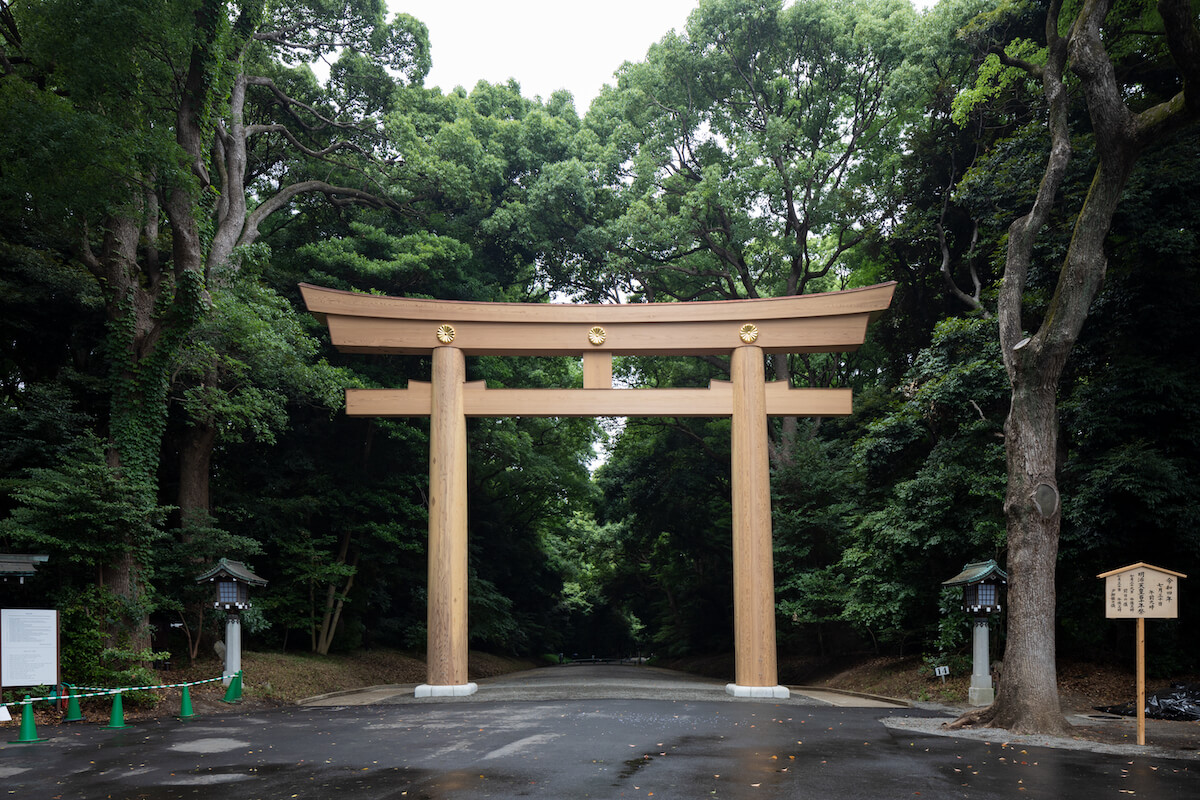
Located in the heart of Tokyo, Meiji Shrine (Meiji Jingu) is surrounded by a lush forest that offers a serene contrast to the city’s bustle. Dedicated to Emperor Meiji—who led Japan’s modernization—and Empress Shoken, the shrine has long been one of Japan’s most visited sacred sites, drawing millions each New Year since its founding. The First Torii Gate, the traditional wooden entrance to the shrine's south approach, stands near Harajuku Station. As a key project for the 100th anniversary of Meiji Shrine’s founding, this gate was rebuilt after a century. On July 4, 2022, a ceremony marking its completion and purification, the Shunko Kiyoharae-shiki, was held, followed by the Kuguri zome-shiki, the ritual first passing through the new structure. The massive pillars of this new Torii were crafted from Yoshino Cedar grown in Kawakami Village, Nara Prefecture. To build a gate of this magnitude—standing 10.1 meters tall with a 15.6-meter-long Kasagi, the principal horizontal beam, timber was sourced from all over Japan, led by the selection of Yoshino Cedar. The project was successfully brought to fruition by the collective efforts of countless people. We spoke with several key figures involved in the rebuilding project to bring you the inside story of how the new First Torii Gate was brought to life. [caption id="attachment_3984" align="alignnone" width="1200"] Photo courtesy of Meiji Shrine[/caption] A Two-Year Search for Timber: The Story of Finding the Perfect Yoshino Cedar for the Pillars Meiji Shrine was established in 1920. Initially, all the shrine's Torii gates were constructed using Taiwan Cypress. Historically, subsequent restorations relied on either Taiwan Cypress or domestic Japanese Cypress. However, with the logging of Taiwan Cypress now banned, and finding domestic Japanese Cypress that met the size requirements of the original Torii proving exceptionally difficult, two full years were dedicated to finding a suitable alternative material. This raises the question: Why was cedar chosen for this rebuilding? We interviewed representatives from Meiji Shrine to get the answer. "Amid various options, including, foreign timbers, glulam, and hybrid materials combining wood and steel, we decided upon the intention of using domestic Japanese wood Shiraki, plain untreated wood. After this decision, cedar was determined to be the most appropriate and domestically procurable timber available. For the two main pillars of the First Torii Gate, we used Yoshino Cedar, while the Kasagi, topmost beam, and Shimaki, the long horizontal beam beneath the Kasagi, utilized cedar sourced from different regions. This makes it the first cedar Torii within the shrine grounds. Wood evokes reverence for nature and conveys warmth and beauty that man-made materials cannot replicate. The grain of the Yoshino Cedar pillars conveys the vital strength nurtured by the land of Yoshino and the blessings of the heavens. The fragrant cedar has resulted in a beautiful finish, and upon seeing the completed First Torii Gate, a single feeling surged within us: simply, 'deep gratitude.'" In order to maintain the size and shape of the original Torii, lumber measuring 15 meters in length and 5 meters in circumference at breast height was required. Finding timber of this magnitude within Japan proved to be an extremely difficult challenge. Starting with the search for standing trees suitable for the pillars, on-site surveys were conducted in numerous forests across the country. Mr. Kaimoto, Chairman and President of YoshinoMeibokuSeizoHanbai, Inc., who was involved in the lumber selection process, stated, "It was difficult to find trees that met the conditions, and even when we did, there was the problem that they were often in locations that made extraction extremely challenging." He continued: "It was at that point that I remembered a thick tree remaining in our company's owned forest in Takahara, Kawakami Village. Upon checking, its circumference was about 4.9 meters, almost exactly the size we were looking for. Fortunately, we were able to find the second tree in the same area. Finding lumber of this size—15 meters in length and with as few knots as possible all the way to the tip—is not easy. We can only say that we were lucky and felt as if this wood was truly chosen by the divine." Yoshino Cedar was used for both the east and west pillars: a tree estimated to be about 280 years old was used for the east side, and one about 260 years old for the west, ensuring both sides were matched with Yoshino Cedar. Logging in a Sacred Atmosphere: The Tense Process of Extraction and Milling Four months after the candidate trees were discovered in Kawakami Village, the Misoma Hajime-sai, Shinto ritual performed before felling sacred trees, was held in December 2014 to begin the logging process. It is said that as the preparations for the ceremony were underway, snow began to fall, dusting the surrounding mountains white and enveloping the entire ritual in a sacred atmosphere. [caption id="attachment_3993" align="alignnone" width="800"] Photo courtesy of NARU Architectural Photography Office[/caption] Before felling, the direction of the fall was determined, and seven or eight surrounding trees that might potentially be hit were cut down in advance to ensure the targeted tree would not be damaged. Furthermore, branches were meticulously laid out like a cushion to prevent scarring from rocks or stumps. The team then succeeded in felling the tree after repeatedly adjusting the cutting angle with chainsaws to keep the direction of the fall precise. After checking the condition of the cut wood for damage or knots, a process called "leaf-drying," a traditional method of seasoning timber where the branches and leaves are left attached on site to draw out a large amount of moisture from the wood and improve its color, was carried out over 12 months. [caption id="attachment_3985" align="alignnone" width="1200"] Photo courtesy of Shimizu Corporation[/caption] After the leaf-drying process, the extraction work began, which involved creating a path to bring the timber down the mountain. Even Mr. Uehira of Uehira Forestry, who undertook the felling and extraction for YoshinoMeibokuSeizoHanbai, Inc. and has experience handling large-diameter timber, recalled that transporting trees of this massive size was a deeply frightening task. He reflected: "The trees were located on a mountainside about 50 meters away, separated by a river, and we had to carry the wood across the river to get it out. We consulted with local forestry specialists and also enlisted the cooperation of construction workers to build the necessary path. Finally, we had people skilled in handling large-diameter wood carry out the felling and extraction. This type of work cannot be done without the help of nature's forces. I was relieved that we were able to transport the timber without any damages." [caption id="attachment_3986" align="alignnone" width="1200"] Photo courtesy of Mototate Co., Ltd.[/caption] The timber, transported from the mountains of Yoshino imbued with profound significance, was moved to the workshop of Miyadaiku, an expert temple and shrine carpenters, with a milling facility Mototate Co., Ltd. in Yamagata prefecture in the Tohoku region of Japan where approximately 600 km away from Nara prefecture. There, the Chona-hajime-sai, a ritual marking the start of woodworking, was held, and the milling process began. Unlike standard construction materials, where one can select from multiple pieces, there was no replacement for this unique timber, raising the question of how to maximize its use. Architect Osamu Kiuchi, who handled the design, and craftsmen from Shimizu Corporation collaborated closely with Miyadaiku, and consulting repeatedly as the meticulous shaving and cutting proceeded. "Cedar is easy to process, but conversely, it is also easily damaged. Therefore, we worked with meticulous care on how to protect the wood, including wrapping it in blankets. Since wood is a living material, and the milling was a one-shot process with no room for error, we paid close attention to the surface texture of the timber, applying precision processing down to the millimeter for the final finish. The Yoshino Cedar possesses tremendous power and presence, and its grain is beautiful. When the work was complete, we felt that a truly magnificent Torii had been created. What is so remarkable about Yoshino timber is the way the trees have been nurtured and cherished over long ages and across generations. I was impressed by the diligent maintenance and management of the forests, especially since large-diameter trees are becoming scarce and difficult to procure."—Mr. Yonekawa, Construction Supervisor, Shimizu Corporation [caption id="attachment_3987" align="alignnone" width="1200"] Scene from the Chona-hajime-sai (ritual marking the start of woodworking) held before the milling process beganPhoto courtesy of Shimizu Corporation[/caption] It is precisely because we are dealing with natural materials that the work is difficult, delicate, and ultimately beautiful. And it is this that makes the resulting structure so special. The collective vision and passion of countless people came together to shape and finalize the timber that would become the pillars of the Torii Gate. Upholding Tradition: Creating New Value Using Contemporary Techniques Architect Osamu Kiuchi, who handled the design, explained: “The most challenging part of the design and processing for this rebuild after 100 years was the pursuit of good form.” "It was decided that the shape and size must adhere to the specifications from the time of the shrine's founding. We proceeded with the design to faithfully reproduce the overall beauty of the Torii as it stood 100 years ago. We had to determine where the excellent dignity of Meiji Shrine's First Torii Gate originated. Since the original blueprints no longer existed, we quantified and determined the precise dimensions by referencing measured values. For the curve of Kasagi, Shimaki, and the Entasis (the gentle bulge of the column) that makes the pillar beautiful, we ran repeated computer simulations, allowing us to generate a shape nearly identical to the measured drawings of the original Torii. While the form is 'tradition,' the method of creation uses contemporary technology; it can truly be called 'the creation of tradition using contemporary technology.'" Thus, the Meiji Shrine First Torii Gate—inheriting the size and shape from a century ago—was milled, processed, finished, and successfully rebuilt through contemporary technology and the dedication of many people. Finally, the metal fittings bearing the Chrysanthemum Crest, the emblem symbolizing the Japanese Imperial Family, that were used on the former Torii were restored and reattached. [caption id="attachment_3988" align="alignnone" width="1200"] Each component of the Torii—the Kasagi (top beam), Shimaki (lower beam), and pillars—was handcrafted by skilled artisans.[/caption] [caption id="attachment_3990" align="alignnone" width="1200"] The Torii components are being transported along Omotesando to Meiji Shrine.Photo courtesy of Kawasumi-Kobayashi Kenji Photograph Office[/caption] [caption id="attachment_3991" align="alignnone" width="1200"] After transport, each part was carefully assembled on-site.Photo courtesy of Kawasumi-Kobayashi Kenji Photograph Office[/caption] [caption id="attachment_3992" align="alignnone" width="1200"] The Chrysanthemum Crest, originally used on the previous Torii, was restored and reattached to the new gate.Photo courtesy of Shimizu Corporation[/caption] The person in charge from Meiji Shrine commented on the successful rebuilding: "As time passes, physical structures are unavoidable subject to decay and damage. However, if they are repairable, we intend to carry on the work, cherishing the spirit and skill of our predecessors. At the same time, we believe that some craftsmanship and materials from the past may be impossible to recreate today. Therefore, we plan to consult with experts and remain committed to the spirit of Onkochishin 'learning from the past to create new value', just as it was in the Meiji era. Although the appearance is the same as the former First Torii, we understand that new cedar timber—primarily Yoshino Cedar—was used, and the latest technology was employed. We believe that the deep dedication and wisdom of modern people, which is arguably equal to or even surpasses that of the time Meiji Shrine was founded, are what enabled this new Torii to be brought into being." The First Torii Gate has been reborn through the combined dedication of people committed to connecting tradition with the future, integrating natural beauty with contemporary technology. When you stand before it and look up, the scale of the timber, the beauty of its grain, and its gentle warmth seem to recall the landscape where these trees once stood for centuries. This is the gateway to Meiji Shrine’s forest, which will continue to welcome visitors for the next 50 or 100 years. When you see the magnificent form of the Yoshino Cedar standing there, please take a moment to feel the connection between humanity and nature, and the fervent passion of the countless individuals who brought this Torii to life over many years. Text: Michiko SatoEdited by: “Nara no Ki no Koto” Editorial Team Information Meiji Shrine (Meiji Jingu)1-1 Yoyogi-Kamizonocho, Shibuya-ku, Tokyo 151-8557URL:https://www.meijijingu.or.jp/
2026.01.22
-
Nara’s Timber Culture Goes Global: “Nara wood Chashitsu”, A Tea House Made of Wood from Nara Prefecture Created by Internationally Active Japanese Creators for Expo 2025 Osaka
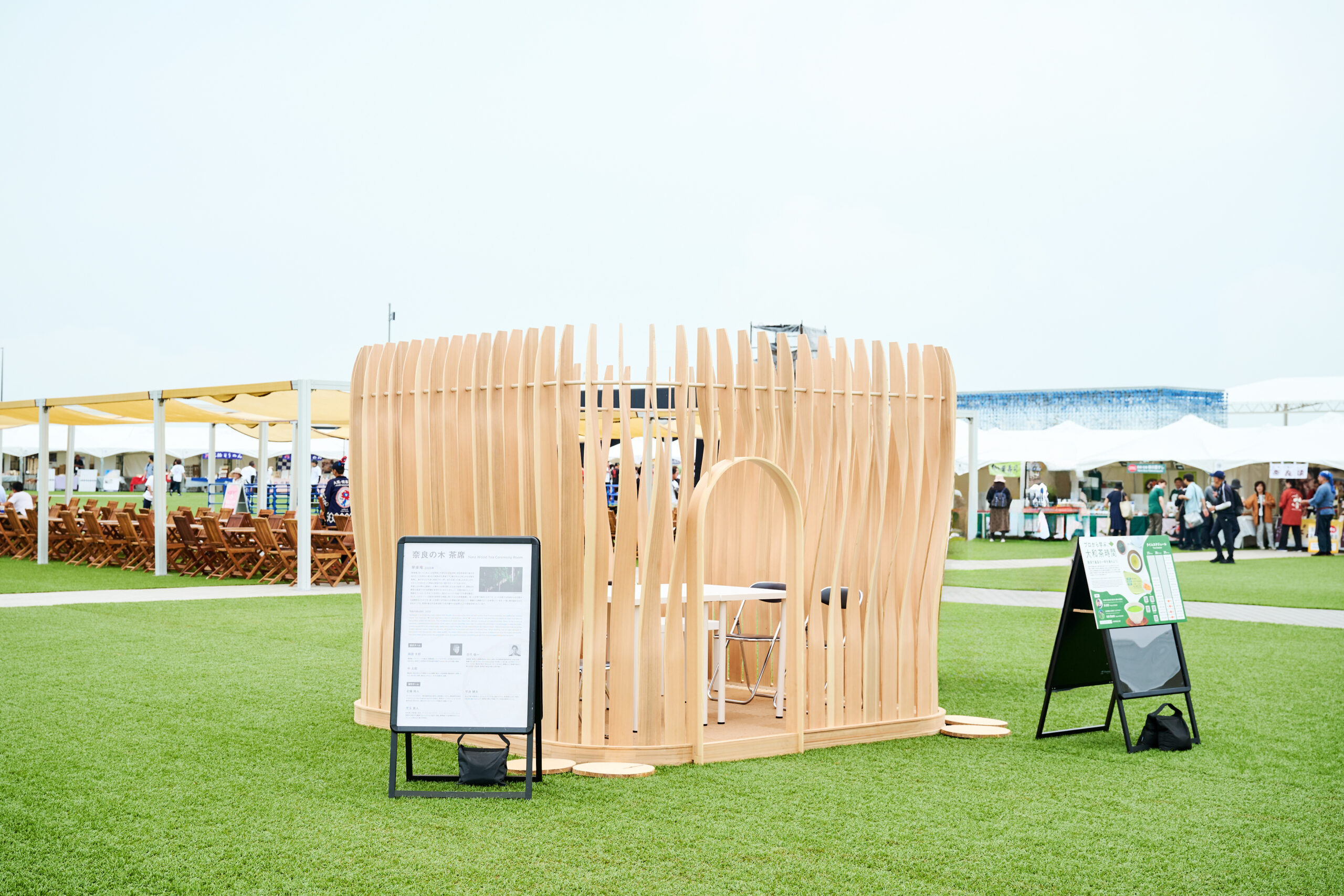
The ALL NARA FESTIVAL, a vibrant showcase of Nara's traditional culture and craftsmanship, took place from May 27th to 29th at the Expo Arena 'Matsuri' (festival). The main stage featured captivating performances of ancient traditions, including the Kasuga Wakamiya On-matsuri, a festival from the World Heritage site "Historic Monuments of Ancient Nara," along with traditional folk performances like Bon Odori and Shishimai lion dances. The venue was divided into nine zones, bustling with people exploring booths that sold and offered experiences with Nara's diverse and appealing food and crafts. Among the various attractions, one pavilion stood out against the green lawn: a stunning chashitsu (tea house) made of Yoshino cedar grown in one of Japan’s most renowned forestry areas, Nara's Yoshino region. This masterpiece was the collaborative effort of six Japanese creators working both in Japan and internationally. We had the opportunity to speak with a few of the team members: Taro Okabe, a Paris-based architect who designed the chashitsu; Yuichi Kodai, an architect based in Switzerland; and Kenta Hirai from the Nara-based design and craft studio “studio jig,” who manufactured the wooden elements of the pavilion structure. We'll delve into the highlights of the chashitsu—brought to life at the Expo through cross-border collaboration—and the unique appeal of Yoshino wood used in the project. “Neiraku-an”: A Mobile Tea House Showcasing the Best of Yoshino Cedar Across the Expo site, national and corporate pavilions showcase cultures, histories, and cutting-edge technologies, offering visitors a vivid sense of the world’s diversity. At the center stands the “The Grand Ring,” certified by Guinness World Records as the world’s largest wooden structure—an awe-inspiring presence that draws visitors into a festive, otherworldly atmosphere. Within this grand setting, the ALL NARA FESTIVAL at the Expo Arena 'Matsuri' hosted nearly 50 vendors, offering everything from handicrafts and agricultural products to local sake (Japanese rice wine brewed in the region) and wooden products—all nurtured by Nara's rich natural environment. As you navigated the lively space, a building with beautiful wood grain caught your eye. This was the mobile tea house “Neiraku-an”, specially built for this event. Throughout the festival, the “Neiraku-an” hosted workshops where visitors could enjoy an authentic art of brewing experience of Yamato-cha (green tea grown in Nara), guided by Yamato-cha producers and Japanese tea instructors. When most people think of a tea house, they imagine a formal, indoor tatami-mat space where tea is served according to strict etiquette. While, this tea house offers a different experience. Here, surrounded by the warmth and fragrant aroma of Yoshino cedar, you can savor the taste of Yamato-cha while enjoying the gentle light and refreshing breeze of the outdoors. Sharing the Appeal of Yoshino Wood Abroad: The Vision of Two Architects Spreading the Charm of Yoshino Wood Overseas The defining feature of the Nara wood Chasitsu “Neiraku-an” is the way thin planks of Yoshino cedar are twisted at identical curvatures and placed at equal intervals to shape the space. The straight grain of the cedar, characteristic of Yoshino wood, is so strikingly beautiful that it invites you to reach out and touch it. How was this innovative design, which gives the impression of "a tea house unlike any you've ever seen," born? We spoke with two Japanese architects based abroad, Taro Okabe and Yuichi Kodai, to find out. ――What kind of dialogue and process did the two of you go through to bring the concept of this chashitsu to life? Okabe:A chashitsu can take many forms. At its most minimal, even drawing a line on the ground to mark off a boundary from the outside world can create the sense of an enclosed space—and that, too, can function as a “chashitsu.” The challenge here was how to design one within the bustling environment of the Expo site, where countless people pass by. We also needed to think about how the structure could be reassembled and reused after the event, using relatively simple components, while still maintaining the essential qualities of a chashitsu. That’s when Kodai suggested using thin slices of Yoshino cedar veneer from Nara Prefecture, to highlight the wood’s natural beauty. Quarter sawn Yoshino cedar is known for a straight and fine grain, and veneer sheet in this sawing pattern is the best way to showcase that inherent quality and beauty. From there, we studied how veneer could be used to create a chashitsu, while intentionally moving away from preconceived notions of what a chashitsu “should” be. Inside the busy Expo grounds, it was impossible to completely block out all external noise. So instead, we thought about controlling sightlines as a way to express the protective, inward-looking nature expected of a chashitsu. By twisting and spacing the veneer planks, we created a dynamic: people standing outside can see through the gaps, but once seated inside, the planks line up parallel to your field of vision, shielding you from outside view and giving a sense of being enclosed and protected. ―― It seems like a very interesting and unique endeavor for two architects to collaborate on a single project. What was that experience like? Kodai:We share a common mission to spread the use of Yoshino wood, and since around 2020 we’ve been working as part of the “YOSHINO WOOD” team to raise international awareness and establish its brand. Collaborating with Nara Prefecture, we’ve been asking ourselves how we can contribute to the promotion of Nara timber from abroad. I believe this project was a natural result of that ongoing effort. ――Could you tell us how the “YOSHINO WOOD” team came together? Okabe:The “YOSHINO WOOD” team consists of four members: Kojiro Yamanaka of ICHI Corporation, who handles exports in Japan, serves as team leader; myself; Kodai; and Yutaka Goto, a university researcher based in Sweden. The Yoshino region of Nara is home to one of the world’s oldest forms of sustainable forestry. With over 500 years of accumulated knowledge, it continues to produce exceptionally high-quality timber. While plantation forests are often considered inferior to natural forests, Yoshino cultivated woods have consistently yielded that rivals, and sometimes surpasses, the quality of natural growth. Today, however, fewer Japanese people live in traditional wooden houses, and demand for tatami rooms or chashitsus has declined. As a result, even Yoshino’s prized cedar and cypress—once regarded as treasures of Japan’s forestry—have become harder to sell. With their societal value fading and the domestic market shrinking, it was Mr. Yamanaka who first suggested, “Why not try selling it overseas?” My initial reaction was, "That's insane!". Wood is everywhere—why would anyone ship it all the way from Japan, on the far edge of Asia, to Europe? To make matters more challenging, in Europe, where we are based, people prefer dark, heavy hardwoods, which are considered premium. Softwoods like Japanese cedar and cypress—lighter, softer, and brighter in color—are the complete opposite. I remember thinking, “How on earth could we sell this?” But soon that hesitation turned into excitement: “This could be a real challenge.” While our main profession is architecture, through the “YOSHINO WOOD” team we are constantly thinking about how to share the value of Yoshino forestry—one of Japan’s true treasures—with people overseas. [caption id="attachment_6333" align="alignnone" width="1179"] Members of the YOSHINO WOOD (from left: Yutaka Goto, Kojiro Yamanaka, Taro Okabe, and Yuichi Kodai).[/caption] Kodai:Our ultimate goal is to see more trees planted so that a steady supply of high-quality Yoshino wood can be maintained for generations. For that to happen, Yoshino wood needs to be used in substantial quantities. While furniture and crafts are wonderful, the actual volume of wood they consume is limited. Currently, we’re working on a project in Norway that uses Yoshino timber for both structures and finishes of a private home. By using large quantities of lumber for projects like this, it leads directly to new cycles of planting. Without that scale of use, the very meaning of our efforts would be lost. To pass Yoshino forestry down to the next generation and beyond, we need to see significant “volume” being used. At the same time, it’s also crucial for Yoshino wood to be used in furniture. This allows people to see the unique character of each piece of wood, and appreciate the high quality. It's essential that we convey both of these values effectively. The Appeal of Yoshino Wood: Blending Story, Engineering, and Physical Showcase ――I’m impressed to hear that you are promoting Yoshino wood overseas with reforestation in mind. Okabe:Reforestation is essential. By cultivating and using trees, we create a cycle that leads to new tree planting and reduces our environmental impact. We've even calculated to ensure the carbon footprint of shipping a single log to a distant location. For example, shipping a single log from Japan to France—by truck, ship, and then truck again—emits around 100 kilograms of CO₂. But that same log stores between 500 and 600 kilograms of carbon. In other words, even with 100 kilograms emitted, the log still stores about six times more carbon. And once the tree is harvested, new trees are planted, which then continue absorbing CO₂. A standing tree absorbs roughly 100 kilograms of CO₂ per year. By maintaining this cycle, even transporting logs overseas results in a clear environmental positive. That’s why it’s important to share not only the historical and cultural significance of Yoshino wood, but also the engineering perspective that explains why it matters. When people hear both sides, they are genuinely fascinated. They're often amazed, saying, ‘This is incredible—why didn’t we know about it before?’ This reaction speaks to the immense potential of Yoshino wood. It’s surprising that such a resource hasn’t yet gained wide recognition overseas, but at the same time, there’s real joy in knowing that we are now the ones pioneering that path. ――What aspects of Yoshino wood do people overseas find most appealing? Kodai:Just yesterday, we had the unveiling of a Yoshino-hinoki kitchen counter that I designed and a Swiss carpenter built. We shipped over a piece of timber from Japan—about four meters long and ten centimeters thick. After working with it, the carpenter told me, ‘I’ve never encountered wood this easy to handle.’ At his workshop, which employs 30 to 40 craftsmen, every single one of them said the same thing: they had never experienced wood with such smooth texture, fragrance, and overall quality. What impressed them most was that it doesn’t crack when cut, it’s soft yet sturdy, and it’s incredibly easy to work with. In Europe, it’s common to shave down about a centimeter on the top and bottom of such a board, but with Yoshino wood, because of its remarkable dimensional stability, only about four millimeters needed to be trimmed. That means far less waste. And unlike hardwoods like oak, which leave your hands covered in resin during processing, Yoshino hinoki keeps your hands clean. That also makes the work much more efficient.Yoshino cypress has also been used for the ceiling of an art gallery in London, arranged in a lattice-like pattern. With most other types of timber, warping and uneven grain would make this kind of application impossible. But Yoshino wood shows straight, beautiful grain, and it stays stable over time without distortion. For people familiar with the nature of wood, the precision makes them wonder, ‘How is this possible? That said, only someone with a trained eye can distinguish these qualities for appropriate applications. Unless you can demonstrate clearly, ‘This wood works especially well for this purpose,’ or ‘it does not work for this purpose’, people will turn to industrial materials like aluminum or steel, which are less prone to change over time. I believe Yoshino wood is truly one-of-a-kind as a stable wood material, and that makes it even more important to preserve the culture and forestry techniques and pass on such a valuable resource for future generations. Okabe:When I think about Yoshino wood as a brand, I feel it’s similar to Wagyu beef. You can find beef anywhere in the world, yet people are willing to pay a premium to import ‘Wagyu’ from Japan. How you open up that kind of market—and the strategy behind it—is fascinating to me. Our first approach wasn't simply showing samples of Yoshino wood at trade fairs. Instead, we wanted people to see the kind of beauty that only Yoshino wood can express. So we carved a seven-meter-long counter-like object from a single Yoshino cypress log and presented it at the then up-and-coming Japanese restaurant OGATA Paris. We invited designers, architects, and media professionals to an event there. The wood had Yoshino’s hallmark: perfectly straight grain, with not a single knot across its seven-meter length. The absence of knots is proof of careful branch pruning. The quality of the wood presented the meticulous cares by foresters since the planting a few hundred years ago—something unique to the way trees are cultivated in Yoshino. The exhibition caught people’s attention, and from there word began to spread. I realized how much the value of wood can change depending on how you show it, and that effective storytelling and presentation are just as important as the material itself. [caption id="attachment_6335" align="alignnone" width="2560"] ©Nicolas Grosmond[/caption] [caption id="attachment_6336" align="alignnone" width="2560"] ©Nicolas Grosmond[/caption] [caption id="attachment_6337" align="alignnone" width="2560"] ©Nicolas Grosmond[/caption] ――What are your goals and visions for your future work? Okabe:Until now, most of our clients overseas have been people with a love for Japan, specifically seeking something ‘Japanese.’ But moving forward, I want us to be able to share the appeal of Yoshino wood with people who have never even been to Japan. That's the challenge ahead for us. Kodai:I’m originally from Kyoto Prefecture, which borders Nara. In Kyoto’s traditional crafts—such as Buddhist household altars and ritual implements—wood from Nara has long been used. That kind of use for traditional high quality craftworks is only possible because the quality is guaranteed. For me, sustaining Yoshino forestry is also about safeguarding Japan’s cultural traditions. I am motivated to make sure that future generations can continue using Yoshino wood. Special Materials and Wood-Bending Techniques from Yoshino The chashitsu, designed overseas with a deep respect for Yoshino wood, was ultimately shaped by the hands of Nara-based woodworker Kenta Hirai, who works in Kawakami Village. Hirai has created beautiful furniture pieces that highlight the unique qualities of Yoshino timber, and he was honored at the 4th Japan Wa Culture Grand Prix. We asked him how he approached building this distinctive chashitsu. ――Mr. Hirai, you primarily focus on furniture. What was your mindset going into the construction of this tea house? Hirai: My priority was not to compromise the designers’ vision. I made sure to check in with them on every detail throughout the process. Since I mainly make furniture, I would never have come up with such an idea for a chashitsu myself. Each piece of board is simple on its own, just bent wood. But when arranged in sequence, they look completely different. A single part might seem ordinary, yet combined, they open up new possibilities. It was a valuable learning experience. [caption id="attachment_6340" align="alignnone" width="2560"] It’s not one solid board. Each element is made from seven sheets of veneer, each 1.5 millimeters thick.[/caption] The flat part at the top and the bottom were formed with a mold, but the curved middle sections were bent by hand. That means no two pieces are ever identical. Those subtle differences give each element its own character, and when assembled together, they form a landscape— it appeared to me almost like the forests of Yoshino. ――The twisted veneers really highlight the beauty of Yoshino cedar’s grain. How did this style of work develop for you? Hirai: I studied woodworking in Ireland, where I learned Free Form Lamination, a technique for bending wood into three-dimensional curves. Honestly, when I returned to Japan, I thought I’d rarely use it. In Ireland, the materials for wood bending were mainly hardwoods, and hardwood with a quality for veneer sheet slicing is rare and expensive. But when I came to Yoshino, I discovered that Yoshino cedar from its cultivated forests was perfect for veneer sheet production—and it’s available in stable supply. To see piles of material so ideally suited for the free form wood bending technique was shocking. It made me realize, “Here, I can really do this.” ――So this unique expression was truly only possible because of Yoshino cedar? Hirai: Exactly. These trees have been cared for over more than a century, and that long stewardship preserves their exceptional quality. That’s what makes Yoshino wood so special. ――What do you hope to pursue going forward? Hirai: Collaborations like this project are something I want to keep challenging myself with. There’s a saying: If you want to go fast, go alone. If you want to go far, go together. Working with others lets me create worlds I could never reach on my own. At the same time, I also want to test how far I can go alone—through my own expression. I’d like to see what’s possible on the world stage by for example taking part in international competitions. Connecting the Charm of Nara's Wood to the World and the Future On the global stage of Expo 2025 Osaka, Kansai, Japan, a new form of chashitsu was born—one that could only be realized with Yoshino cedar. The craftsmanship behind this project is a tribute to the people who have protected and nurtured these forests, using a cultivation method passed down through generations in the Yoshino region. Through the work of creators inspired by Nara’s timber, interest in Nara wood is now spreading even to overseas markets. “Sharing the beauty of wood and passing it on to the future”—perhaps the more people experience its charm, the more strength we will gain to nurture the forests of tomorrow. Text: Michiko SatoPhotography: Haruka Kuwana
2025.09.30